 Sudoku
 You’ve filled in every naked single, checked for hidden singles, and even applied naked pairs wherever you could find them. Yet the grid is still stuck, crammed with pencil marks that refuse to narrow down. Sound familiar?
The problem might be that you’re looking at cells instead of looking at candidates. That’s exactly the mental shift that hidden pairs require — and once you make it, an entire class of eliminations opens up.
In this guide, we’ll explain exactly what hidden pairs are, how they differ from naked pairs, why the logic works, and how to spot them in your own grids. We’ll walk through a real example with before-and-after diagrams.
✅ What Are Hidden Pairs in Sudoku?
A hidden pair is an intermediate candidate-elimination technique. The word “hidden” refers to the fact that the pair digits are buried among other candidates in the cells — unlike a naked pair, where the pair digits are the only ones present.
A hidden pair occurs when two candidates appear in only two cells within the same row, column, or box. Those cells may contain other candidates as well, but because the two “hidden” candidates must occupy those two cells, all other candidates can be removed from those cells.
Notice the key difference from naked pairs: with a naked pair, you eliminate candidates from other cells in the unit. With a hidden pair, you eliminate candidates from inside the pair cells themselves.
🧠 How Hidden Pairs Work (The Logic)
Imagine you’re looking at Box 5 (the center 3×3 box) of a Sudoku grid. You examine every cell in the box and count where each candidate appears:
- Candidate 4 appears only in R5C4 and R5C6.
- Candidate 8 appears only in R5C4 and R5C6.
No other cell in Box 5 contains a 4 or an 8. This means:
- Option A: R5C4 = 4 and R5C6 = 8
- Option B: R5C4 = 8 and R5C6 = 4
Either way, 4 and 8 fully occupy these two cells. Any other candidates sitting in R5C4 or R5C6 are impossible — they can be safely removed.
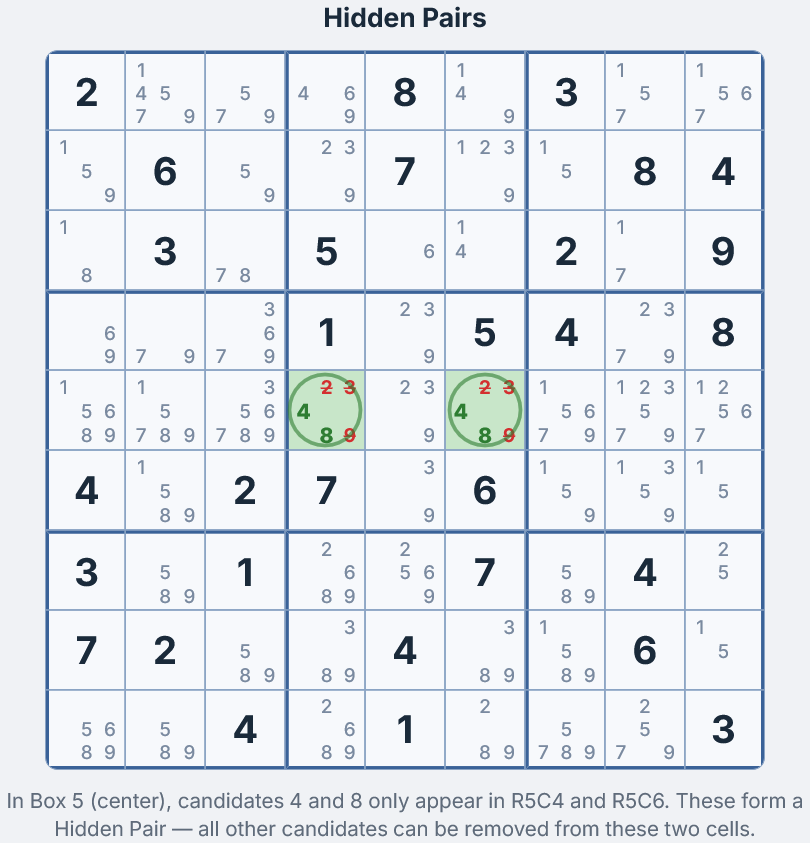
In our example, both cells originally contain {2, 3, 4, 8, 9}. After applying the hidden pair, the candidates 2, 3, and 9 are stripped out, leaving both cells with just {4, 8}.
To find hidden pairs, count candidates, not cells. Ask yourself: “Which candidates in this unit appear in only two places?” If two candidates share the exact same two cells, you’ve found a hidden pair.
🔎 Step-by-Step Example
Let’s walk through a concrete hidden pair on a real grid. We’re examining Box 5 with candidates 4 and 8.
Step 1: Count candidate positions
Look at every cell in Box 5 and note where each candidate appears:
- R4C5 has candidates {2, 3, 9}
- R5C4 has candidates {2, 3, 4, 8, 9}
- R5C5 has candidates {2, 3, 9}
- R5C6 has candidates {2, 3, 4, 8, 9}
- R6C5 has candidates {3, 9}
Candidates 4 and 8 appear only in R5C4 and R5C6 — nowhere else in Box 5. That’s a hidden pair!
Step 2: Strip the extra candidates
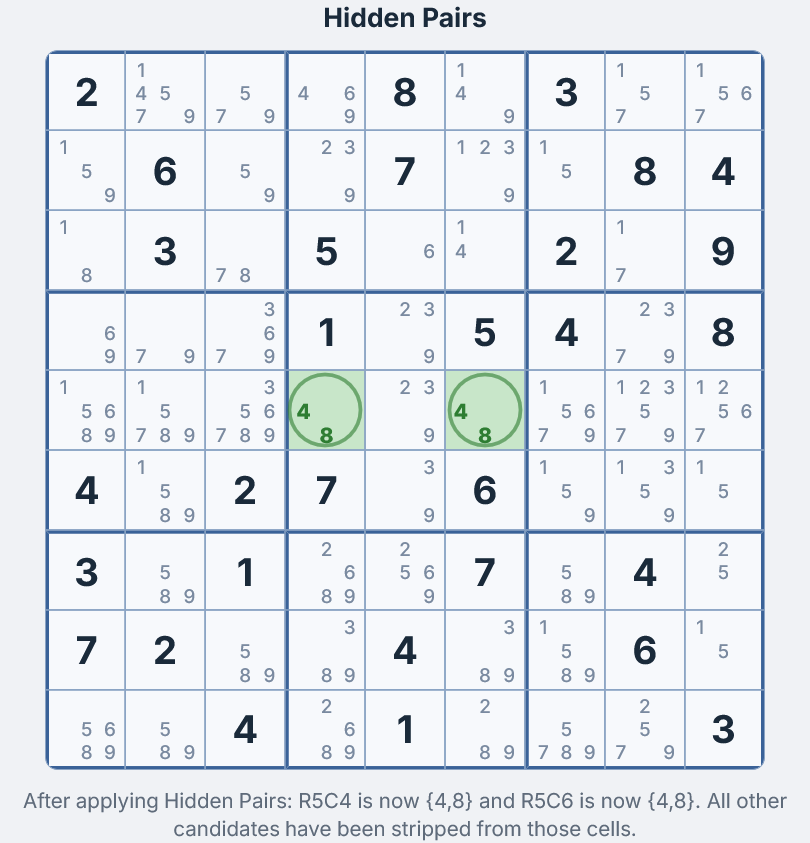
Since 4 and 8 must go in R5C4 and R5C6, remove all other candidates from those two cells:
- R5C4: remove 2, 3, 9 → left with {4, 8}
- R5C6: remove 2, 3, 9 → left with {4, 8}
That’s 6 candidate eliminations from a single hidden pair!
Step 3: Chain reaction
Notice what happened — by stripping the hidden pair cells down to {4, 8}, they now form a naked pair! This means you can also eliminate 4 and 8 from all other cells in Row 5 that contain them. Hidden pairs often create cascading eliminations.
Find: Two candidates that appear in only two cells within a single unit.
Eliminate: All other candidates from those two cells.
Result: Cleaner cells, potential naked pairs, and a simpler grid.
🕵️ How to Spot Hidden Pairs
1. Pick a unit (row, column, or box).
2. For each candidate (1–9), count how many cells in that unit contain it.
3. Note any candidate that appears in exactly two cells.
4. If two such candidates share the same two cells, you have a hidden pair.
5. Remove all other candidates from those two cells.
Hidden pairs are often easier to find in boxes than in rows or columns, because boxes have fewer cells to scan (just 9 in a compact square).
🔄 Hidden Pairs vs Naked Pairs
| Feature | Naked Pair | Hidden Pair |
|---|---|---|
| What you look for | Two cells with only the same 2 candidates | Two candidates that appear in only 2 cells |
| Focus | Look at cells | Look at candidates |
| Where eliminations happen | Other cells in the unit | Inside the pair cells themselves |
| Extra candidates in pair cells? | No (only the pair digits) | Yes (that’s what makes them “hidden”) |
| After applying | Other cells lose candidates | Pair cells become a naked pair |
Think of hidden pairs and naked pairs as two sides of the same coin. A naked pair looks at cells and eliminates outward. A hidden pair looks at candidates and eliminates inward. Together, they cover a huge range of intermediate eliminations.
📌 Hidden Pairs in Rows, Columns & Boxes
- Row: If two candidates appear only in the same two cells of a row, remove all other candidates from those cells.
- Column: If two candidates appear only in the same two cells of a column, remove all other candidates from those cells.
- Box: If two candidates appear only in the same two cells of a box, remove all other candidates from those cells.
When a hidden pair is found in a box, the resulting naked pair may also affect the row or column those cells share — creating a chain of eliminations across multiple units.
⚠️ Common Mistakes to Avoid
1. Confusing hidden pairs with naked pairs
Remember: naked pairs eliminate from other cells. Hidden pairs eliminate from within the pair cells. Mixing them up means eliminating the wrong candidates.
2. Not counting all cells in the unit
For a valid hidden pair, the two candidates must appear in exactly two cells within the unit. If a third cell also contains one of them, it’s not a hidden pair.
3. Removing the pair candidates
Never remove the hidden pair digits themselves! You’re keeping 4 and 8 — you’re removing everything else from those cells.
4. Only checking rows
Hidden pairs appear in rows, columns, and boxes. Don’t skip boxes — they’re often the easiest place to find them.
📅 When to Look for Hidden Pairs
- Basic techniques: Naked Singles, Hidden Singles, Full House.
- Intermediate techniques: Naked Pairs, Hidden Pairs, Naked Triples, Pointing Pairs, Box/Line Reduction.
- Advanced techniques: X-Wing, Swordfish, XY-Wing.
- Expert techniques: Jellyfish, Chains, Almost Locked Sets.
Puzzles requiring hidden pairs are typically rated Medium or higher. Our medium puzzles and hard puzzles are great places to practice.
🚀 Beyond Hidden Pairs: Triples & Quads
| Technique | Candidates | Cells | Difficulty |
|---|---|---|---|
| Hidden Pair | 2 | 2 | Intermediate |
| Hidden Triple | 3 | 3 | Advanced |
| Hidden Quad | 4 | 4 | Expert |
Master hidden pairs first. The candidate-counting skill transfers directly to hidden triples (three candidates in exactly three cells) and hidden quads.
Every hidden subset has a naked counterpart: Naked Pairs, Naked Triples, and Naked Quads. Learning both families gives you a complete toolkit for intermediate solving.
🎯 Practice Hidden Pairs
- Use pencil marks: Always fill in all candidates before searching for patterns.
- Count, don’t scan: For each candidate, count how many cells in the unit contain it.
- Start with boxes: They’re compact and easier to count.
- Verify with the solver: Use our Sudoku solver to confirm your findings.
Sudoku Medium
Puzzles that regularly require hidden pairs and other intermediate techniques.
▶ Play Medium SudokuSudoku Hard
Tougher grids where hidden pairs are one of several tools you’ll need.
▶ Play Hard SudokuFrequently Asked Questions
A hidden pair occurs when two candidates appear only in the same two cells within a row, column, or box. All other candidates can be removed from those two cells, leaving only the pair.
A naked pair has two cells containing only the pair digits — eliminations happen in other cells. A hidden pair has two candidates restricted to two cells, but those cells contain extra candidates — eliminations happen inside the pair cells.
After basic techniques (naked singles, hidden singles) and naked pairs. Hidden pairs are an intermediate strategy commonly needed in medium and hard puzzles.
Yes! Hidden pairs work in any Sudoku unit — rows, columns, and 3×3 boxes. The logic is identical.
Focus on candidates, not cells. For each unit, count which candidates appear in only two cells. If two candidates share the same two cells, that’s a hidden pair.