 Sudoku
 If you’ve ever solved a sudoku puzzle, you’ve almost certainly used Hidden Singles without realising it. Every time you looked at a row, column, or box and said “the 5 can only go here”, you were applying this technique. It’s the most fundamental and frequently used strategy in sudoku.
While Naked Singles are easy to spot — a cell with only one candidate — Hidden Singles are trickier because the target cell may contain several candidates. The digit is “hidden” among them. What makes it special is that it’s the only cell in its row, column, or box where that digit can go.
In this guide we’ll explain exactly what Hidden Singles are, why they work, and walk through a real example with before-and-after diagrams. We’ll also cover how to scan for them efficiently and where they fit in the solving hierarchy.
✅ What Are Hidden Singles in Sudoku?
A Hidden Single is one of the two most basic sudoku techniques, alongside the Naked Single. The word “hidden” means the digit doesn’t stand out at first glance — it’s buried among other candidates in the cell.
A Hidden Single occurs when a candidate digit appears in only one cell within a row, column, or box. That cell may contain other candidates as well, but since this is the only possible location for the digit in that unit, the cell must contain it. All other candidates are removed from the cell.
Think about it this way: every sudoku unit (row, column, or box) must contain each digit from 1 to 9 exactly once. If a particular digit can only fit in one cell within a unit, that cell must hold that digit — regardless of how many other candidates it has.
🧠 How Hidden Singles Work (The Logic)
Imagine you’re examining Box 1 (the top-left 3×3 block) of a sudoku grid. The box already contains the digits 3, 4, 5, 7, 6, and 9, with three empty cells remaining.
You check where each missing digit can go:
- Digit 1 could go in R1C3, R3C2, or other cells.
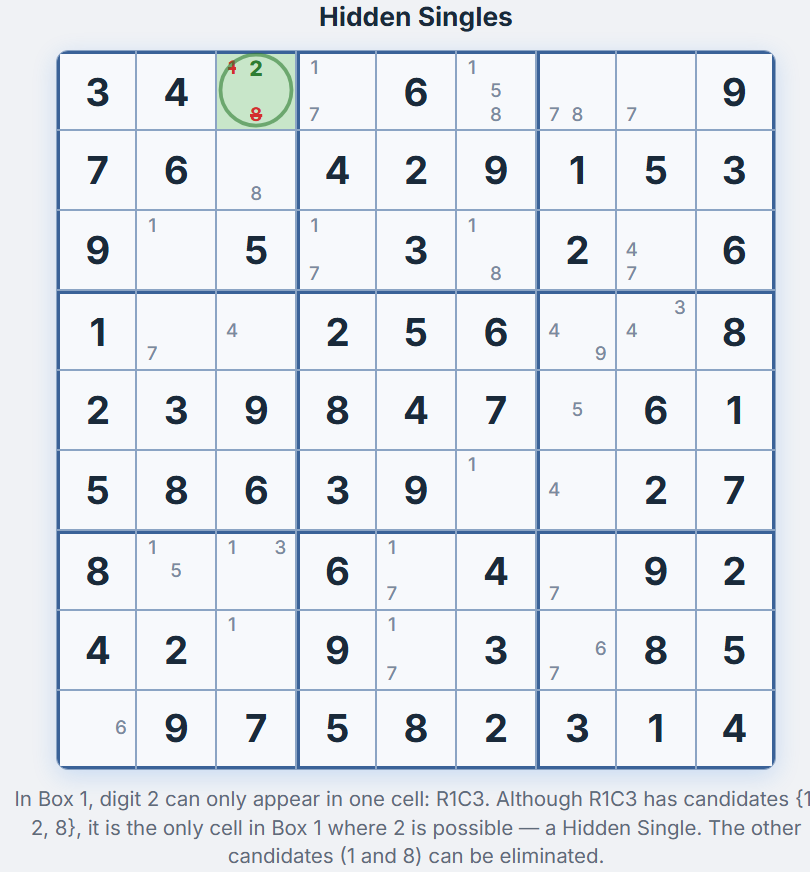
- Digit 2 can only go in R1C3 — it’s blocked from every other empty cell by 2s already in their rows or columns.
- Digit 8 could go in R1C3 or R2C3.
Digit 2 has only one possible cell in Box 1. Even though R1C3 also has candidates 1 and 8, 2 must go there because there’s nowhere else for it. That’s a Hidden Single.
With Naked Singles you look at a cell and ask “does it have only one candidate?” With Hidden Singles you look at a digit and ask “does it have only one possible cell in this unit?” Both approaches find placements, but Hidden Singles often uncover answers that Naked Singles miss.
🔎 Step-by-Step Example
Let’s walk through a concrete Hidden Single on a real grid. We’re looking at Box 1 where digit 2 is a Hidden Single in cell R1C3.
Step 1: Identify the Hidden Single
Scan the empty cells in Box 1 and check where digit 2 can be placed:
- R1C3 has candidates {1, 2, 8} — digit 2 is possible here.
- R2C3 has only candidate {8} — digit 2 is not possible (Row 2 already has a 2 at R2C5).
- R3C2 has only candidate {1} — digit 2 is not possible (Column 2 already has a 2 at R8C2).
Digit 2 can only go in R1C3 within Box 1. That’s a Hidden Single!
Step 2: Place the Digit
Since digit 2 must go in R1C3, we place it there and remove all other candidates (1 and 8) from the cell:
- R1C3: {1, 2, 8} → 2
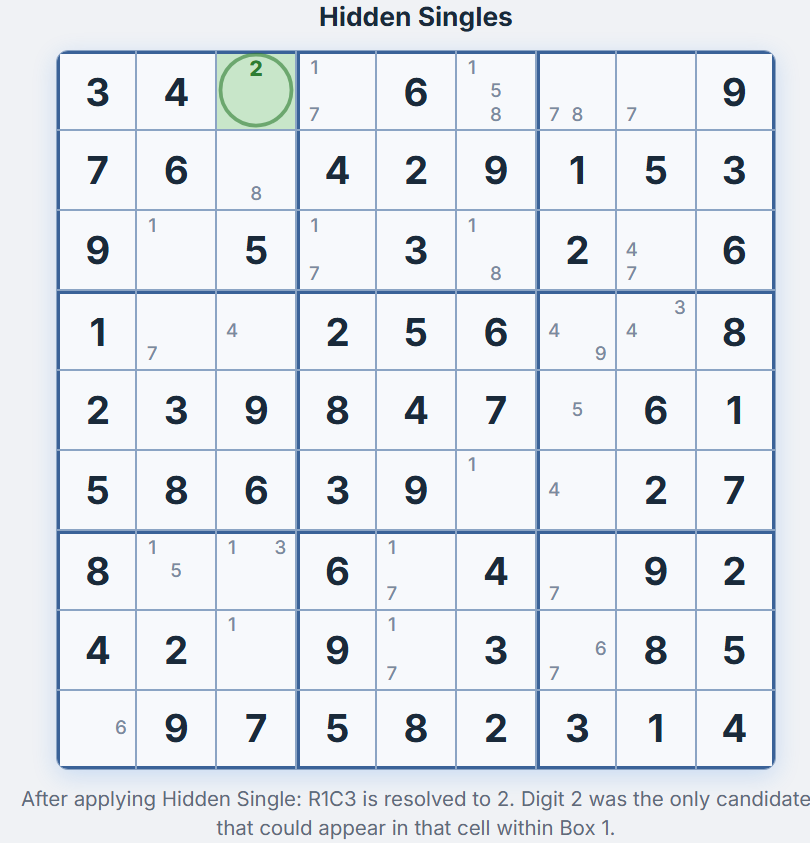
Step 3: Continue Solving
Placing digit 2 in R1C3 also removes 2 as a candidate from every other cell in Row 1, Column 3, and Box 1. This often reveals new Naked Singles or more Hidden Singles, creating a cascade of easy placements that can carry you through large sections of the puzzle.
Find: A digit that can only appear in one cell within a row, column, or box.
Place: That digit in the cell and remove all other candidates.
Result: A solved cell, fewer candidates across related units, and often more singles to find.
🕵️ How to Spot Hidden Singles in Your Grid
Hidden Singles are among the easiest techniques to apply, but they require a systematic scanning approach. Here’s the most efficient method:
1. Pick a digit (say, 5).
2. Look at every row, column, and box where 5 is still missing.
3. For each unit, count how many cells can hold digit 5. If only one cell can — that’s a Hidden Single.
4. Place the digit and move to the next unit or digit.
5. Cycle through all digits 1–9, then repeat.
This “cross-hatching” approach is the bread and butter of sudoku solving. By checking one digit at a time across multiple units, you systematically uncover every Hidden Single available.
Start with digits that already appear frequently in the grid. If there are already six 7s on the board, digit 7 only needs three more placements — and each remaining unit has fewer cells to check. Frequent digits yield Hidden Singles faster.
🔄 Hidden Singles in Rows, Columns & Boxes
Hidden Singles work identically in all three types of sudoku unit:
- Row: A digit appears as a candidate in only one cell of a row → place it there.
- Column: A digit appears as a candidate in only one cell of a column → place it there.
- Box: A digit appears as a candidate in only one cell of a 3×3 box → place it there.
Box-based Hidden Singles are the easiest to find visually because you can quickly cross-hatch rows and columns against a compact 3×3 area. Row and column Hidden Singles often require checking more cells but can reveal placements that box scanning misses.
A Hidden Single is valid in whichever unit you find it. If digit 2 can only go in one cell within a box, that’s enough — you don’t need to check the row and column too. However, scanning all three unit types ensures you find every available placement.
⚠️ Common Mistakes to Avoid
Hidden Singles are conceptually simple, but beginners sometimes stumble on these points:
1. Missing Candidates in Other Cells
Before declaring a Hidden Single, make sure the digit truly cannot go anywhere else in the unit. Double-check by scanning the row, column, and box constraints for every empty cell in that unit.
2. Confusing Hidden Singles with Naked Singles
A Naked Single has only one candidate in the cell. A Hidden Single may have many candidates — what’s unique is that one of them can’t go anywhere else in the unit. Both result in a placement, but you find them differently.
3. Not Scanning All Three Unit Types
Many beginners scan only boxes and miss Hidden Singles in rows or columns. Always check all three unit types for maximum coverage.
4. Forgetting to Update Candidates
After placing a Hidden Single, remember to remove that digit as a candidate from all other cells in the same row, column, and box. Missing this step can lead to errors later.
After placing a Hidden Single, immediately check the affected row, column, and box for new singles. One placement often triggers another, especially in easy puzzles where a chain of singles can solve the entire grid.
📅 When to Look for Hidden Singles
Hidden Singles are the very first technique you should apply at the start of every puzzle — and you should keep applying them after every deduction:
- Foundation techniques: Naked Singles, Hidden Singles, full-house.
- Intermediate techniques: Naked Pairs, Hidden Pairs, Naked Triples, Hidden Triples, pointing pairs, box/line reduction.
- Advanced techniques: X-Wing, Swordfish, XY-Wing.
- Expert techniques: Jellyfish, chains, almost locked sets.
Most easy puzzles can be solved entirely with Naked Singles and Hidden Singles. Even in harder puzzles, you should always exhaust all available singles before moving on to more complex techniques. Every intermediate or advanced technique you apply should be followed by another sweep for singles, as new ones often emerge.
Every sudoku puzzle requires Hidden Singles — they are used at every difficulty level. Our easy sudoku puzzles can typically be solved with singles alone, while medium and hard puzzles need additional techniques between rounds of singles scanning.
🚀 Hidden Singles vs Naked Singles
Hidden Singles and Naked Singles are the two fundamental placement techniques in sudoku. Here’s how they compare:
| Technique | What You Look At | Condition | Result | Difficulty |
|---|---|---|---|---|
| Naked Single | A cell | Cell has only 1 candidate | Place that candidate | Easiest |
| Hidden Single | A unit (row/col/box) | Digit fits in only 1 cell | Place that digit | Easy |
| Hidden Pair | A unit | 2 digits in only 2 cells | Eliminate other candidates | Intermediate |
| Hidden Triple | A unit | 3 digits in only 3 cells | Eliminate other candidates | Intermediate |
Notice the pattern: a Hidden Single is simply the N = 1 case of the hidden subset family. One digit in one cell — that’s the simplest possible hidden pattern. As N increases to 2 and 3, you get Hidden Pairs and Hidden Triples.
Naked Singles and Hidden Singles are two sides of the same coin. In any fully pencil-marked grid, every Hidden Single will eventually become a Naked Single as other candidates are eliminated. Using both approaches together ensures you find every available placement as quickly as possible.
🎯 Practice Hidden Singles
Hidden Singles are best learned by practising on real puzzles. Here are some tips:
- Use pencil marks: Fill in all candidates so you can see at a glance where each digit can go. Our pencil-mark mode makes this easy.
- Cross-hatch systematically: Pick one digit at a time. Check every row, column, and box for that digit. When only one cell is possible in a unit, place it.
- Start with easy puzzles: Easy puzzles rely heavily on singles, so they’re the perfect training ground.
- Verify with the solver: Use our sudoku solver to confirm your placements are correct.
Easy Sudoku
Puzzles designed to be solved primarily with Naked and Hidden Singles. The perfect place to practise this technique.
▶ Play Easy SudokuClassic Sudoku
Standard 9×9 puzzles across all difficulty levels. Hidden Singles are your bread and butter in every game.
▶ Play Classic SudokuSudoku Solver
Enter your puzzle and watch the solver find Hidden Singles and other techniques automatically, step by step.
▶ Open the SolverFrequently Asked Questions
A Hidden Single occurs when a candidate digit appears in only one cell within a row, column, or box. That cell may contain other candidates too, but since this is the only place the digit can go in that unit, the cell must contain it. All other candidates are removed from the cell.
A Naked Single is a cell with only one candidate remaining — the digit is obvious. A Hidden Single is a cell with multiple candidates, but one of those candidates appears nowhere else in the unit. Naked Singles are found by looking at cells; Hidden Singles are found by looking at where digits can go.
Pick a unit (row, column, or box) and check where each unsolved digit can be placed. If a digit can only go in one cell within that unit, you have found a Hidden Single. Place the digit there and remove all other candidates from that cell.
Hidden Singles are a beginner-level technique — one of the first strategies every sudoku solver should learn. Together with Naked Singles, they form the foundation of sudoku solving and can solve most easy puzzles entirely on their own.
Yes. A Hidden Single can occur in any of the three unit types — rows, columns, and boxes. A digit might be unique to one cell in a box, or in a row, or in a column. Experienced solvers scan all three types of unit to find every available Hidden Single before moving to harder techniques.