 Sudoku
 You’ve learned Hidden Pairs — two candidates restricted to two cells in a unit. But what happens when the pattern involves three candidates locked into three cells? The cells are cluttered with extra digits, the triple is harder to see, and many solvers walk right past it.
This is where Hidden Triples come in — a powerful extension of subset logic that can strip away multiple wrong candidates in one move. Once you see that three specific digits appear in only three cells within a unit, you can clean those cells down to just the triple digits and often trigger a cascade of further deductions.
In this guide we’ll explain exactly what Hidden Triples are, why the logic works, and walk through a real example with before-and-after diagrams. We’ll also cover common mistakes, how to spot them quickly, and where they sit in the solving hierarchy.
✅ What Are Hidden Triples in Sudoku?
A Hidden Triple is an intermediate candidate-elimination technique and the three-cell extension of the Hidden Pair. The word “hidden” means the triple digits are buried among other candidates in the cells — they don’t stand out until you notice that those three digits appear nowhere else in the unit.
A Hidden Triple occurs when three candidates appear only in the same three cells within a row, column, or box. Those cells may also contain other candidates. Because the three digits are restricted to exactly these three cells, all other candidates can be removed from them.
The crucial difference from Naked Triples: in a Naked Triple the cells contain only the triple digits and you eliminate those digits from other cells. In a Hidden Triple the triple digits are mixed in with extras — you eliminate the non-triple candidates from the three cells themselves.
🧠 How Hidden Triples Work (The Logic)
Imagine you’re examining Box 1 (the top-left 3×3 block) of a sudoku grid. You check where each unsolved digit can go and notice something interesting:
- Digit 6 can only appear in R1C1 and R2C1.
- Digit 7 can only appear in R1C1, R2C1, and R3C1.
- Digit 8 can only appear in R1C1, R2C1, and R3C1.
All three digits (6, 7, 8) are confined to the same three cells. Think about what this means:
- There are three digits and three cells that can hold them.
- Each cell must ultimately contain one of those three digits.
- No matter how you assign 6, 7, and 8 among these cells, all three cells are consumed.
Because R1C1, R2C1, and R3C1 are fully committed to housing digits 6, 7, and 8, no other candidate in those cells can be correct. You can safely remove every non-triple candidate from these three cells.
You don’t need to know which cell gets which digit. The Hidden Triple guarantees that the three digits are “locked” into those three cells. That’s enough to eliminate every other candidate from them — just like a Hidden Pair, but with one extra cell and one extra digit.
🔎 Step-by-Step Example
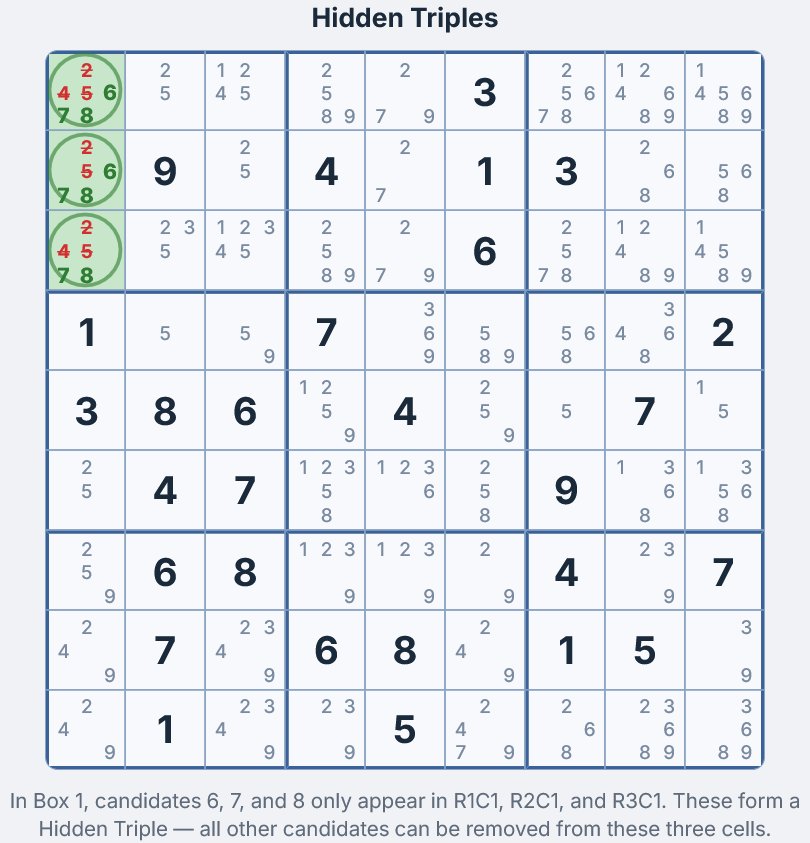
Let’s walk through a concrete Hidden Triple on a real grid. We’re looking at Box 1 with the triple digits {6, 7, 8}.
Step 1: Identify the Triple
Check where each unsolved digit can appear within Box 1. Focus on digits that are restricted to just a few cells:
- Digit 6 appears only in R1C1 and R2C1 — two cells.
- Digit 7 appears only in R1C1, R2C1, and R3C1 — three cells.
- Digit 8 appears only in R1C1, R2C1, and R3C1 — three cells.
All three digits are confined to exactly three cells. That’s a Hidden Triple!
Step 2: Make the Eliminations
The triple locks digits 6, 7, and 8 into R1C1, R2C1, and R3C1. We remove all non-triple candidates from these three cells:
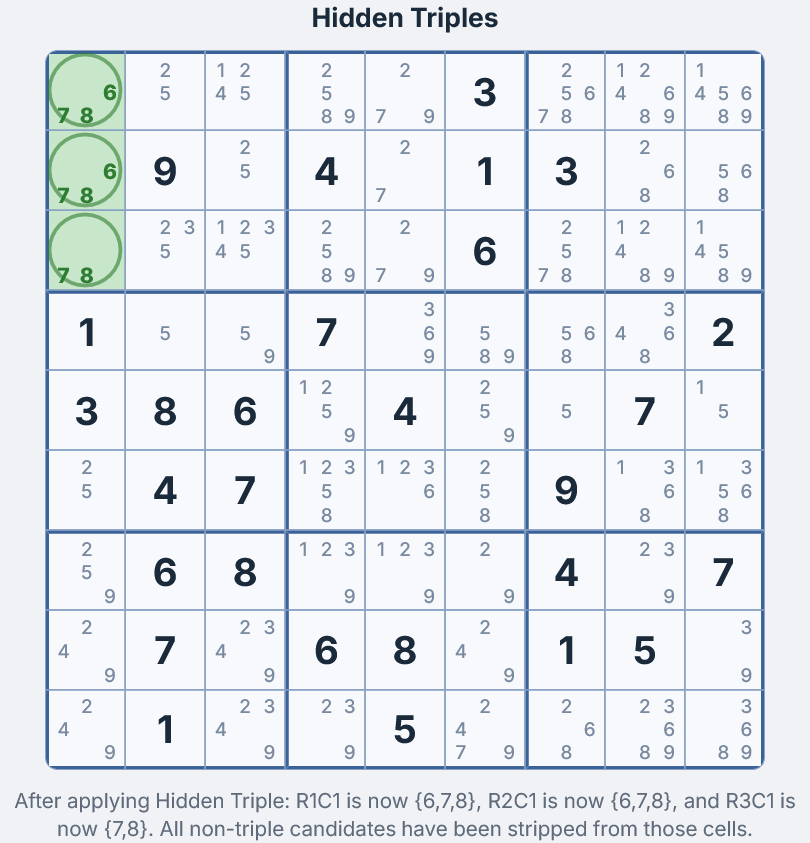
- R1C1: remove 2, 4, 5 — {2, 4, 5, 6, 7, 8} → {6, 7, 8}
- R2C1: remove 2, 5 — {2, 5, 6, 7, 8} → {6, 7, 8}
- R3C1: remove 2, 4, 5 — {2, 4, 5, 7, 8} → {7, 8}
Step 3: Continue Solving
We removed 8 candidates in total. The cleaned-up cells now form a Naked Triple/Pair pattern that can trigger further eliminations across Column 1 and the rest of the grid. With fewer candidates to track, subsequent deductions become much easier to find.
Find: Three candidates that appear in only three cells within the same unit.
Eliminate: All other candidates from those three cells.
Result: Cleaner cells, potential naked subsets, and a simpler grid.
🕵️ How to Spot Hidden Triples in Your Grid
Hidden Triples are among the hardest intermediate techniques to spot because the triple digits are buried under extra candidates. Here’s a practical method:
1. Pick a unit (row, column, or box).
2. For each unsolved digit, list which cells can hold it.
3. Look for three digits that each appear in only 2 or 3 cells — and those cells are the same three cells.
4. Remove all non-triple candidates from those three cells.
5. Move to the next unit and repeat.
The key difference from Naked Triples: instead of looking at what candidates the cells contain, you’re looking at where specific digits can go. When three digits are confined to three cells, that’s your Hidden Triple.
Start by finding digits that appear in only two cells within a unit. If you find one, look for two more digits confined to the same cells (plus perhaps one additional cell). In our example, digit 6 appeared in only two cells — that was the entry point to noticing the full triple.
🔄 Hidden Triples in Rows, Columns & Boxes
Hidden Triples work identically in all three types of sudoku unit:
- Row: Three candidates appear only in three cells of the same row → strip the extras from those cells.
- Column: Three candidates appear only in three cells of the same column → strip the extras from those cells.
- Box: Three candidates appear only in three cells of the same 3×3 box → strip the extras from those cells.
Box-based Hidden Triples tend to be the easiest to spot visually because the three cells are spatially close together. Our example above is a Box 1 triple where all three cells happen to share Column 1 as well, making it valid in both units simultaneously.
If a Hidden Triple’s three cells share the same row (or column) and the same box, the triple is valid in both units. The eliminations are the same — remove non-triple candidates from the three cells — but recognising the overlap can help you spot the pattern from either direction.
⚠️ Common Mistakes to Avoid
Hidden Triples are conceptually straightforward but tricky to apply correctly. Watch out for these common errors:
1. Eliminating the Triple Digits from Other Cells
This is the most common mistake. In a Hidden Triple, you remove non-triple candidates from the triple cells. You do not remove the triple digits from other cells — that’s what a Naked Triple does.
2. Missing a Digit’s Occurrence Outside the Triple
Before declaring a Hidden Triple, verify that each of the three digits truly appears nowhere else in the unit. If digit 6 secretly appears in a fourth cell, the pattern is invalid.
3. Requiring All Three Digits in Every Cell
A cell in a Hidden Triple does not need all three digits. R3C1 in our example has only {7, 8} from the triple — it’s still a valid member as long as the three digits collectively are restricted to these three cells.
4. Confusing Hidden Triples with Naked Triples
In a Naked Triple the cells contain only the triple digits and you eliminate those digits from other cells. In a Hidden Triple the cells contain extra candidates and you eliminate the extras from the triple cells. They’re opposite operations.
After every Hidden Triple elimination, immediately re-check the affected cells. Stripping candidates often reveals naked pairs, naked triples, or pointing patterns that weren’t visible before.
📅 When to Look for Hidden Triples
Hidden Triples sit in the intermediate tier of sudoku strategies, slightly above Hidden Pairs:
- Basic techniques: Naked singles, hidden singles, full-house.
- Intermediate techniques: Naked Pairs, Hidden Pairs, Naked Triples, Hidden Triples, pointing pairs, box/line reduction.
- Advanced techniques: X-Wing, Swordfish, XY-Wing.
- Expert techniques: Jellyfish, chains, almost locked sets.
Exhaust simpler subset techniques before hunting for Hidden Triples. If Naked Pairs, Hidden Pairs, and Naked Triples don’t crack the puzzle open, look for three digits restricted to three cells — they’re often the key to breaking through.
Puzzles that require Hidden Triples are typically rated Medium or Hard. Our medium sudoku puzzles and hard sudoku puzzles are great places to practise spotting them.
🚀 Hidden Pairs vs Triples vs Quads
Hidden Triples belong to the hidden subsets family. The logic scales up and down:
| Technique | Digits | Cells | Eliminate | Difficulty |
|---|---|---|---|---|
| Hidden Pair | 2 | 2 | Non-pair candidates from pair cells | Intermediate |
| Hidden Triple | 3 | 3 | Non-triple candidates from triple cells | Intermediate |
| Hidden Quad | 4 | 4 | Non-quad candidates from quad cells | Advanced |
The pattern is always the same: N candidates restricted to exactly N cells in a unit. Remove every other candidate from those cells. Master Hidden Pairs first, then triples become intuitive, and quads are just one more step up.
Every hidden subset has a “naked” counterpart. A Naked Triple finds three cells that contain only three candidates — those candidates are removed from other cells. Hidden and naked techniques are complementary: what one misses, the other catches.
🎯 Practice Hidden Triples
The best way to master Hidden Triples is to practise on real puzzles. Here are some tips:
- Use pencil marks: Fill in all candidates before looking for intermediate patterns. Our pencil-mark mode makes this easy.
- Focus on digit placement: Instead of staring at cells, ask “where can digit X go in this unit?” for each unresolved digit. When three digits share the same three cells, you’ve found your triple.
- Build on Hidden Pairs: When you find a Hidden Pair, check if a third digit is also confined to those same cells (plus one more). Pairs often extend to triples.
- Verify with the solver: Use our sudoku solver to confirm your eliminations are correct.
Medium Sudoku
Puzzles that regularly require Hidden Triples and other intermediate techniques. Perfect for practising this strategy.
▶ Play Medium SudokuHard Sudoku
More challenging grids where Hidden Triples are one of several tools you’ll need. Great for building a complete toolkit.
▶ Play Hard SudokuSudoku Solver
Enter your puzzle and watch the solver find Hidden Triples and other techniques automatically, step by step.
▶ Open the SolverFrequently Asked Questions
A Hidden Triple occurs when three candidates appear only in the same three cells within a row, column, or box. Those cells may also contain other candidates. Because the three digits are restricted to those cells, all other candidates can be removed from them.
No. Each cell needs at least two of the three triple digits, but not necessarily all three. For example, cells with {6, 7, 8}, {6, 7, 8}, and {7, 8} form a valid Hidden Triple for digits 6, 7, and 8.
In a Naked Triple, the three cells contain only the triple digits and you eliminate those digits from other cells in the unit. In a Hidden Triple, three candidates are restricted to three cells that also hold extra candidates — you eliminate the extras from the triple cells themselves. They’re complementary techniques.
After exhausting basic techniques (naked singles, hidden singles), Naked Pairs, Hidden Pairs, and Naked Triples. Hidden Triples are an intermediate strategy typically needed in medium to hard puzzles.
A Hidden Pair uses two candidates and two cells; a Hidden Triple uses three candidates and three cells. The elimination logic is identical — remove non-group candidates from the group cells — but triples are harder to find because you need to track three digits across three cells.