 Sudoku
 You’ve found all the naked singles and hidden singles. You’ve checked every row, column, and box. The grid still has dozens of empty cells and your pencil marks look like a sea of tiny numbers. What now?
This is where Naked Pairs come in — a clean, elegant technique that eliminates candidates by exploiting a simple logical constraint. Once you learn to see them, they’ll become one of the most-used tools in your solving toolkit.
In this guide we’ll cover exactly what Naked Pairs are, why the logic works, how to find them in your own grids, and the common traps to avoid. We’ll walk through a real example with before-and-after diagrams so every step is crystal clear.
✅ What Are Naked Pairs in Sudoku?
A Naked Pair (sometimes called a “conjugate pair”) is an intermediate candidate-elimination technique. The name “naked” refers to the fact that the two cells contain only the pair digits — nothing else is hiding alongside them.
A Naked Pair occurs when two cells in the same row, column, or box each contain exactly the same two candidates and no other candidates. Because one cell must hold one digit and the other cell must hold the other digit, both candidates can be eliminated from all other cells in that shared unit.
That’s the entire concept. Two cells, two candidates, same unit. Let’s see why this logic is airtight.
🧠 How Naked Pairs Work (The Logic)
Imagine you’re looking at Row 4 of a sudoku grid. You notice two cells:
- R4C1 has candidates: {2, 9}
- R4C5 has candidates: {2, 9}
Both cells contain only the digits 2 and 9. No other candidates. Think about what this means:
- Option A: R4C1 = 2 and R4C5 = 9
- Option B: R4C1 = 9 and R4C5 = 2
Those are the only two possibilities. Either way, both 2 and 9 are fully accounted for by these two cells. No other cell in Row 4 can contain a 2 or a 9. So you can safely remove candidates 2 and 9 from every other cell in that row.
You don’t need to figure out which cell gets which digit. The Naked Pair guarantees that the two digits are “locked” into those two cells. That’s enough information to eliminate them from everywhere else in the unit.
🔎 Step-by-Step Example
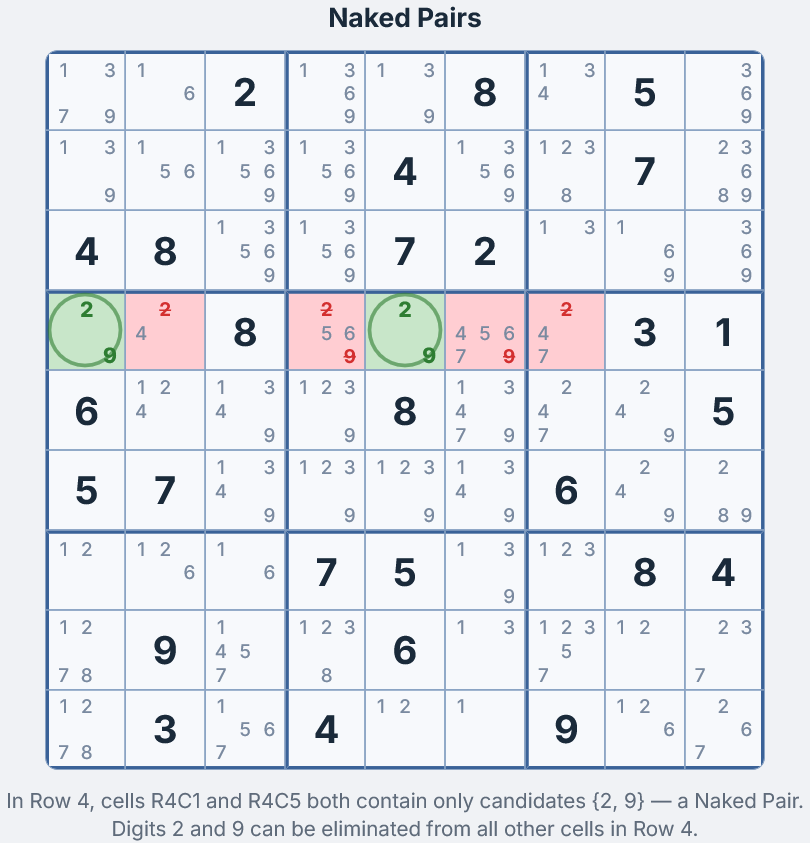
Let’s walk through a concrete Naked Pair on a real grid. We’re looking at Row 4 with candidates 2 and 9.
Step 1: Identify the Pair
Scan through Row 4 and look for cells that contain exactly two candidates. In this grid:
- R4C1 contains only candidates {2, 9}.
- R4C5 contains only candidates {2, 9}.
Both cells have the exact same two candidates and nothing else — that’s a Naked Pair!
Step 2: Make the Eliminations
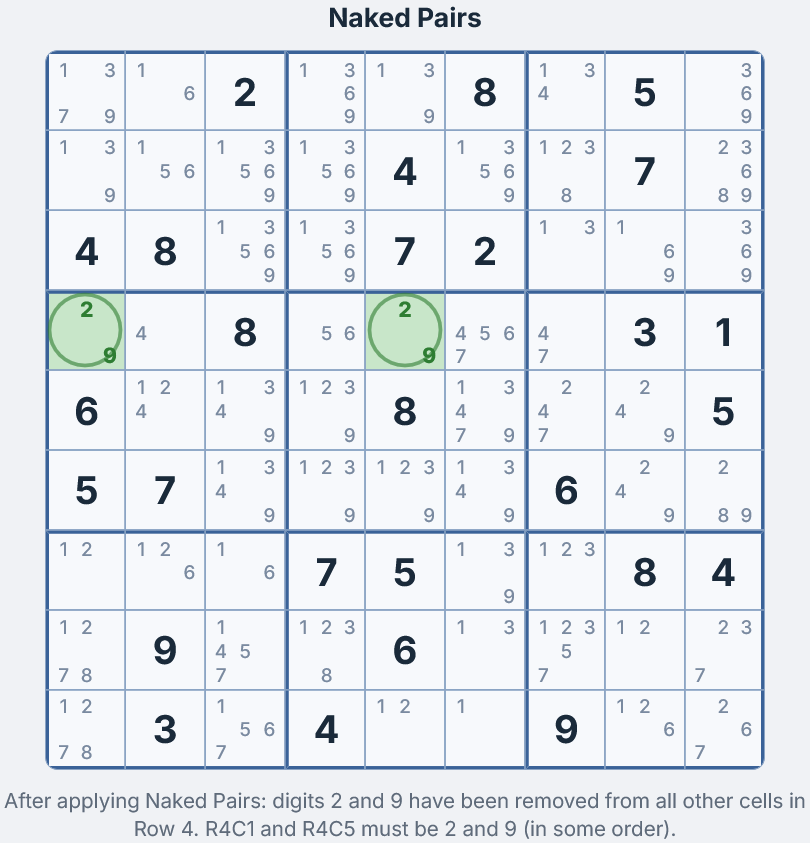
Because the Naked Pair locks digits 2 and 9 into R4C1 and R4C5, we can remove candidates 2 and 9 from every other cell in Row 4. In this example, that means:
- R4C2: remove 2 (leaving only {4})
- R4C4: remove 2 and 9 (leaving {5, 6})
- R4C6: remove 9 (leaving {4, 5, 6, 7})
- R4C7: remove 2 (leaving {4, 7})
Step 3: Continue Solving
Look at the result — R4C2 has been reduced to a single candidate {4}, which means it’s now a naked single! One Naked Pair elimination just solved a cell directly. The remaining cells in Row 4 also have fewer candidates, which may trigger further deductions elsewhere in the grid.
Find: Two cells in the same unit (row, column, or box) that each contain exactly the same 2 candidates.
Eliminate: Those 2 candidates from all other cells in that unit.
Result: Fewer candidates, potential naked singles, and a simpler grid.
🕵️ How to Spot Naked Pairs in Your Grid
Finding Naked Pairs is surprisingly straightforward once you know what to look for. Here’s a systematic scanning method:
1. Look at each row, column, and box in turn.
2. Within that unit, find cells that contain exactly two candidates.
3. Compare those two-candidate cells. If any two cells have the same pair, you’ve found a Naked Pair.
4. Eliminate those two candidates from all other cells in that unit.
5. Move to the next unit and repeat.
The key visual cue is cells with only two pencil marks. These are your “pair candidates.” When two of them match in the same unit, you’ve struck gold.
Start by scanning rows, since they’re the easiest to read left-to-right. Then check columns, and finally boxes. With practice, you’ll develop an eye for matching pairs and spot them almost instantly.
🔄 Naked Pairs in Rows, Columns & Boxes
Naked Pairs work identically in all three types of sudoku unit:
- Row: Two cells in the same row share the same two candidates → eliminate from other cells in that row.
- Column: Two cells in the same column share the same two candidates → eliminate from other cells in that column.
- Box: Two cells in the same 3×3 box share the same two candidates → eliminate from other cells in that box.
Box-based Naked Pairs are particularly powerful because the elimination can affect cells in multiple rows and columns simultaneously, potentially triggering cascading deductions.
Sometimes a Naked Pair shares more than one unit — for example, two cells might be in the same row and the same box. In that case, you can eliminate from both units: all other cells in the row and all other cells in the box. Double the eliminations!
⚠️ Common Mistakes to Avoid
Naked Pairs are conceptually simple, but beginners often make a few common errors:
1. Cells With More Than Two Candidates
A Naked Pair requires both cells to contain exactly two candidates. If one cell has {2, 5, 9} and another has {2, 9}, that’s not a Naked Pair — the first cell has three candidates. Don’t confuse this with a Hidden Pair (a different technique).
2. Non-Matching Pairs
Two cells with exactly two candidates each are only a Naked Pair if the candidates are the same. {2, 9} and {3, 7} are not a pair. {2, 9} and {2, 7} are not a pair either. The candidates must match exactly.
3. Eliminating from the Pair Cells
Never remove candidates from the Naked Pair cells themselves! The eliminations apply to other cells in the unit. The pair cells keep their candidates — they define the pattern.
4. Forgetting to Check All Units
A Naked Pair can appear in any row, column, or box. Don’t stop after checking rows — always scan columns and boxes too. Box-based Naked Pairs are often overlooked but can be very powerful.
After every Naked Pair elimination, immediately re-check the affected cells. Removing candidates often creates new naked singles or reveals additional pairs and patterns that weren’t visible before.
📅 When to Look for Naked Pairs
Naked Pairs sit in the “intermediate” tier of sudoku techniques. Here’s where they fit in a typical solving hierarchy:
- Basic techniques: Naked singles, hidden singles, full-house.
- Intermediate techniques: Naked Pairs, naked triples, hidden pairs, hidden triples, pointing pairs, box/line reduction.
- Advanced techniques: X-Wing, Swordfish, XY-Wing, colouring.
- Expert techniques: Jellyfish, chains, almost locked sets, forcing nets.
You should exhaust basic techniques (singles) before searching for Naked Pairs. They’re typically the first intermediate technique a solver learns, and once you’re comfortable with them, they become almost automatic to spot.
If a puzzle requires Naked Pairs, it’s typically rated Medium or higher. Many medium puzzles feature at least one Naked Pair. Our medium sudoku puzzles and hard sudoku puzzles are great places to practise spotting them.
🚀 Beyond Naked Pairs: Naked Triples & Quads
Naked Pairs are the simplest member of a family called naked subsets. The same logic scales up:
| Technique | Cells | Candidates | Difficulty |
|---|---|---|---|
| Naked Pair | 2 | 2 | Intermediate |
| Naked Triple | 3 | 3 | Intermediate |
| Naked Quad | 4 | 4 | Advanced |
A Naked Triple occurs when three cells in a unit together contain exactly three candidates (each cell has a subset of those three). A Naked Quad extends this to four cells and four candidates. The elimination logic is the same — those candidates can be removed from all other cells in the unit.
Master Naked Pairs first. Once the two-cell, two-candidate pattern feels natural, extending it to triples and quads becomes much easier.
Every naked subset has a “hidden” counterpart. A Hidden Pair finds two candidates that only appear in two cells of a unit — the other candidates are removed from those cells. Naked and hidden techniques complement each other: what one misses, the other finds.
🎯 Practice Naked Pairs
The best way to get comfortable with Naked Pairs is to practise on real puzzles. Here are some tips:
- Use pencil marks: Always fill in all candidates before looking for intermediate patterns. Our pencil-mark mode makes this easy.
- Start with medium puzzles: Medium grids regularly feature Naked Pairs without requiring advanced techniques on top.
- Scan systematically: Check every row first (look for cells with exactly two candidates), then columns, then boxes.
- Verify with the solver: After an elimination, use our sudoku solver to confirm your grid is still valid.
Medium Sudoku
Puzzles that regularly require Naked Pairs and other intermediate techniques. Perfect for practising this strategy.
▶ Play Medium SudokuHard Sudoku
More challenging grids where Naked Pairs are one of several tools you’ll need. Great for building a complete toolkit.
▶ Play Hard SudokuSudoku Solver
Enter your puzzle and watch the solver find Naked Pairs and other techniques automatically, step by step.
▶ Open the SolverFrequently Asked Questions
A Naked Pair occurs when two cells in the same row, column, or box each contain exactly the same two candidates and no other candidates. Because one cell must hold one digit and the other cell must hold the other, you can safely eliminate both candidates from every other cell in that shared unit.
Look for Naked Pairs after filling in all pencil marks and exhausting basic techniques like naked singles and hidden singles. Naked Pairs are an intermediate technique that bridges the gap between basic solving and advanced strategies like X-Wings or Swordfish.
Scan each row, column, and box for cells that contain exactly two candidates. If you find two cells in the same unit with the identical pair of candidates, you have a Naked Pair. Remove those two candidates from all other cells in that unit.
In a Naked Pair, the two cells contain only the pair digits — nothing else. In a Hidden Pair, two candidates appear together in only two cells of a unit, but those cells may also contain other candidates. A Hidden Pair lets you remove the extra candidates from those two cells, leaving only the pair.
Yes! Naked Pairs work in any sudoku unit — rows, columns, and 3×3 boxes. The logic is identical regardless of the unit type: if two cells in the same unit share exactly two candidates, those candidates can be removed from all other cells in that unit.