 Sudoku
 You’ve mastered Naked Pairs. You can spot two cells with two matching candidates almost instantly. But what happens when the pattern involves three cells and three digits? The grid looks more complex, the cells don’t always contain the same candidates, and it’s easy to miss what’s right in front of you.
This is where Naked Triples come in — a slightly trickier extension of the same subset logic that can eliminate candidates from up to six cells in one move. Once you understand they work exactly like pairs but with one extra cell and one extra digit, they become surprisingly easy to find.
In this guide we’ll explain exactly what Naked Triples are, why the logic is airtight, and walk through a real example with before-and-after diagrams. We’ll also cover common mistakes, how to spot them quickly, and where they sit in the solving hierarchy.
✅ What Are Naked Triples in Sudoku?
A Naked Triple is an intermediate candidate-elimination technique and the three-cell extension of the Naked Pair. The word “naked” means the cells contain only digits from the triple’s set — no extra candidates are hiding alongside them.
A Naked Triple occurs when three cells in the same row, column, or box each contain only candidates from the same set of three digits. Each cell holds 2 or 3 of those digits. Because the three digits are locked into those three cells, they can be eliminated from all other cells in that unit.
The crucial detail that trips up many solvers: not every cell needs all three candidates. A cell with {1, 3} is a perfectly valid member of a Naked Triple for digits {1, 3, 9}. As long as every candidate in the cell is part of the triple’s three digits, it counts.
🧠 How Naked Triples Work (The Logic)
Imagine you’re examining Row 4 of a sudoku grid. Three cells stand out:
- R4C4 has candidates: {1, 3, 9}
- R4C8 has candidates: {1, 3}
- R4C9 has candidates: {1, 3}
Every candidate in each cell is drawn from the same set: {1, 3, 9}. Think about what this means:
- There are three digits (1, 3, 9) and three cells.
- Each cell must ultimately hold one of those three digits.
- No matter how you assign 1, 3, and 9 to these three cells, all three digits are accounted for.
Because 1, 3, and 9 are fully consumed by R4C4, R4C8, and R4C9, no other cell in Row 4 can contain a 1, 3, or 9. You can safely remove those candidates from every other cell in the row.
You don’t need to figure out which cell gets which digit. The Naked Triple guarantees that the three digits are “locked” into those three cells. That’s enough information to eliminate them from everywhere else in the unit — just like a Naked Pair, but with one extra cell and one extra digit.
🔎 Step-by-Step Example
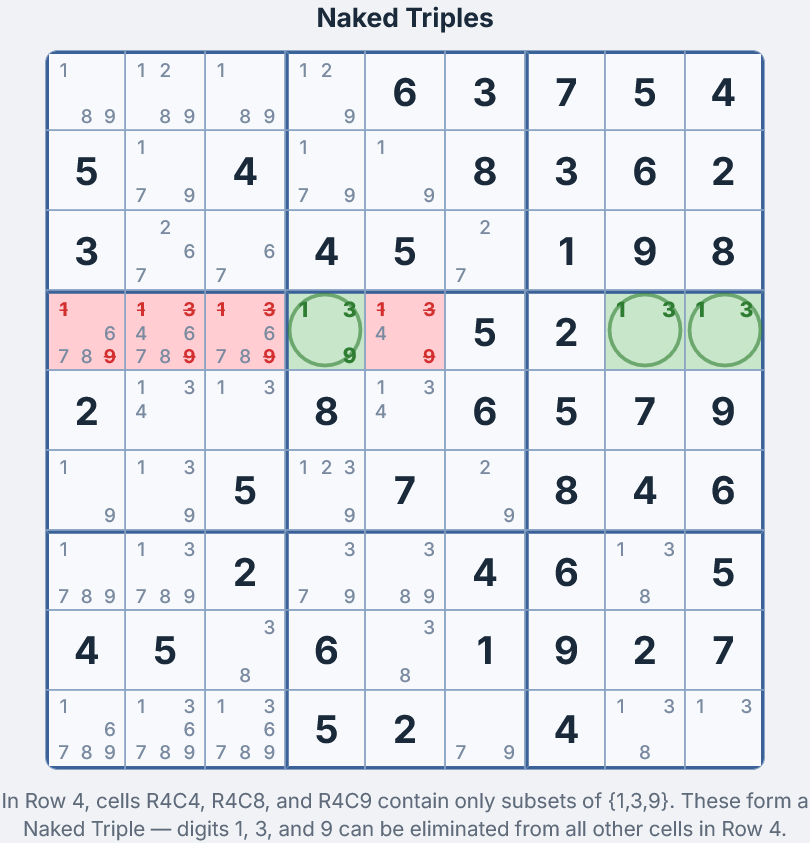
Let’s walk through a concrete Naked Triple on a real grid. We’re looking at Row 4 with the triple digits {1, 3, 9}.
Step 1: Identify the Triple
Scan Row 4 for cells whose candidates are subsets of a three-digit set. In this grid:
- R4C4 contains candidates {1, 3, 9} — all three triple digits.
- R4C8 contains candidates {1, 3} — a subset of {1, 3, 9}.
- R4C9 contains candidates {1, 3} — same subset.
All three cells contain only digits from {1, 3, 9}. That’s a Naked Triple!
Step 2: Make the Eliminations
The triple locks digits 1, 3, and 9 into R4C4, R4C8, and R4C9. We can remove candidates 1, 3, and 9 from every other cell in Row 4:
- R4C1: remove 1 and 9 — {1, 6, 7, 8, 9} → {6, 7, 8}
- R4C2: remove 1, 3, and 9 — {1, 3, 4, 6, 7, 8, 9} → {4, 6, 7, 8}
- R4C3: remove 1, 3, and 9 — {1, 3, 6, 7, 8, 9} → {6, 7, 8}
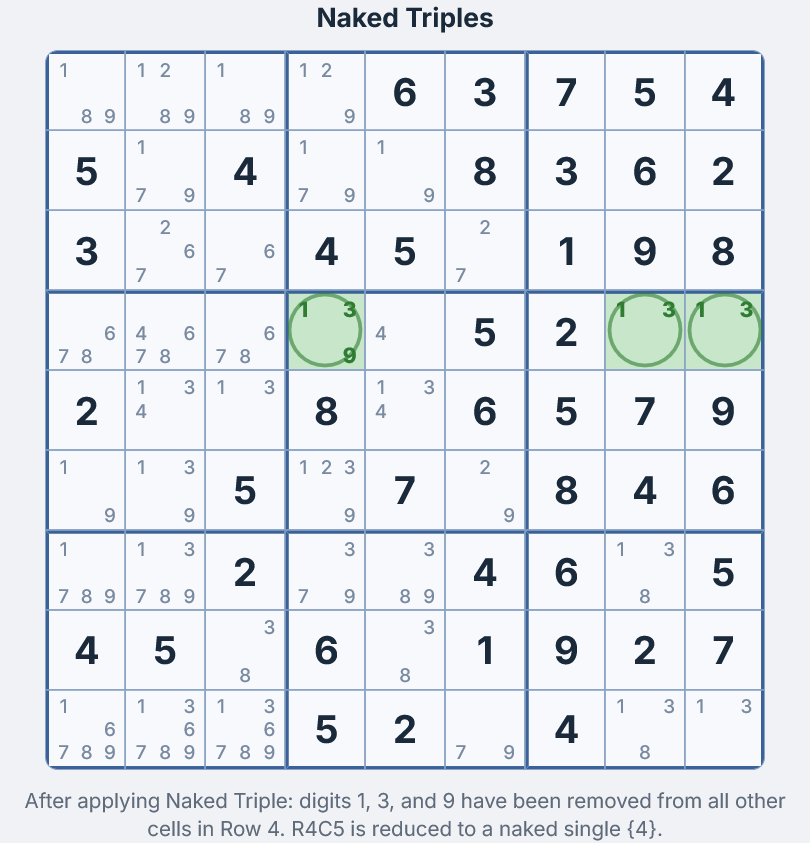
- R4C5: remove 1, 3, and 9 — {1, 3, 4, 9} → {4}
Step 3: Continue Solving
Look at the result — R4C5 has been reduced to a single candidate {4}, meaning it’s now a naked single! One Naked Triple elimination just solved a cell directly and removed 11 candidates in total. The remaining cells in Row 4 have significantly fewer candidates, which can trigger further deductions across the grid.
Find: Three cells in the same unit whose candidates are all subsets of the same 3 digits.
Eliminate: Those 3 digits from all other cells in the unit.
Result: Fewer candidates, potential naked singles, and a simpler grid.
🕵️ How to Spot Naked Triples in Your Grid
Naked Triples are trickier to spot than Naked Pairs because the three cells don’t need identical candidates. Here’s a practical method:
1. Look at each row, column, and box in turn.
2. Find cells with two or three candidates.
3. Take the union of candidates across any three such cells. If the union contains exactly three digits, you’ve found a Naked Triple.
4. Eliminate those three digits from all other cells in the unit.
5. Move to the next unit and repeat.
The key visual cue: look for clusters of cells with small candidate counts (2 or 3). When three of them share the same three digits — even in different combinations — that’s your triple.
Start by finding cells with exactly two candidates. If two cells share the same pair — like {1, 3} and {1, 3} — look for a third cell in the same unit that contains a subset of those digits plus one more. In our example, {1, 3} + {1, 3} + {1, 3, 9} = a Naked Triple of {1, 3, 9}.
🔄 Naked Triples in Rows, Columns & Boxes
Naked Triples work identically in all three types of sudoku unit:
- Row: Three cells in the same row share three candidates → eliminate from other cells in that row.
- Column: Three cells in the same column share three candidates → eliminate from other cells in that column.
- Box: Three cells in the same 3×3 box share three candidates → eliminate from other cells in that box.
Box-based Naked Triples are especially powerful because eliminations affect cells across multiple rows and columns, potentially triggering cascading deductions.
If all three cells of a Naked Triple fall within the same row and the same box, you can eliminate from both units. This doubles the elimination potential and can unlock multiple follow-up deductions in a single move.
⚠️ Common Mistakes to Avoid
Naked Triples are conceptually simple but easy to get wrong in practice. Watch out for these common errors:
1. Requiring All Three Candidates in Every Cell
This is the most common mistake. A Naked Triple does not require each cell to contain all three digits. Cells with {1, 3}, {1, 9}, and {3, 9} form a perfectly valid triple for {1, 3, 9} — none of them has all three candidates.
2. Including Cells With Extra Candidates
Every candidate in a triple cell must be one of the three triple digits. If a cell has {1, 3, 5}, it cannot be part of a Naked Triple for {1, 3, 9} because 5 is not in the set. That cell might be part of a Hidden Triple instead.
3. Eliminating from the Triple Cells
Never remove candidates from the triple cells themselves! Eliminations apply only to the other cells in the unit. The triple cells keep their candidates — they define the pattern.
4. Confusing Naked Triples with Hidden Triples
In a Naked Triple, the cells contain only the triple digits. In a Hidden Triple, three digits appear in only three cells of a unit, but those cells may also have other candidates. Different technique, different eliminations.
After every Naked Triple elimination, immediately re-check the affected cells. Removing candidates often creates new naked singles or reveals additional pairs and triples that weren’t visible before.
📅 When to Look for Naked Triples
Naked Triples sit in the intermediate tier of sudoku strategies, slightly above Naked Pairs:
- Basic techniques: Naked singles, hidden singles, full-house.
- Intermediate techniques: Naked Pairs, Naked Triples, hidden pairs, hidden triples, pointing pairs, box/line reduction.
- Advanced techniques: X-Wing, Swordfish, XY-Wing.
- Expert techniques: Jellyfish, chains, almost locked sets.
Exhaust Naked Pairs before hunting for Naked Triples. If you can’t find any pairs, start looking for triples — they’re often the key to cracking medium and hard puzzles that seem impossible with simpler techniques.
Puzzles that require Naked Triples are typically rated Medium or Hard. Our medium sudoku puzzles and hard sudoku puzzles are great places to practise spotting them.
🚀 Naked Pairs vs Triples vs Quads
Naked Triples belong to the naked subsets family. The logic scales up and down:
| Technique | Cells | Candidates | Max Eliminations | Difficulty |
|---|---|---|---|---|
| Naked Pair | 2 | 2 | 14 | Intermediate |
| Naked Triple | 3 | 3 | 18 | Intermediate |
| Naked Quad | 4 | 4 | 20 | Advanced |
The pattern is always the same: N cells in a unit together contain exactly N candidates. Those N digits can be removed from all other cells in the unit. Master Naked Pairs first, then triples become intuitive, and quads are just one more step up.
Every naked subset has a “hidden” counterpart. A Hidden Triple finds three candidates that only appear in three cells — the other candidates are removed from those cells. Naked and hidden techniques complement each other perfectly: what one misses, the other catches.
🎯 Practice Naked Triples
The best way to master Naked Triples is to practise on real puzzles. Here are some tips:
- Use pencil marks: Fill in all candidates before looking for intermediate patterns. Our pencil-mark mode makes this easy.
- Start with medium puzzles: Medium grids regularly feature Naked Triples without requiring expert techniques on top.
- Build on Naked Pairs: When you find a pair, check nearby cells for a possible third member. Pairs often extend to triples.
- Verify with the solver: Use our sudoku solver to confirm your eliminations are correct.
Medium Sudoku
Puzzles that regularly require Naked Triples and other intermediate techniques. Perfect for practising this strategy.
▶ Play Medium SudokuHard Sudoku
More challenging grids where Naked Triples are one of several tools you’ll need. Great for building a complete toolkit.
▶ Play Hard SudokuSudoku Solver
Enter your puzzle and watch the solver find Naked Triples and other techniques automatically, step by step.
▶ Open the SolverFrequently Asked Questions
A Naked Triple occurs when three cells in the same row, column, or box each contain only candidates from the same set of three digits. Not every cell needs all three — each holds a subset of 2 or 3 of those digits. The three digits can be eliminated from all other cells in that unit.
No. Each cell must contain only candidates that are part of the three triple digits, but a cell can have just two. For example, {1, 3, 9}, {1, 3}, and {1, 3} form a valid Naked Triple for digits 1, 3, and 9.
A Naked Pair uses two cells and two candidates; a Naked Triple uses three cells and three candidates. The elimination logic is identical — the digits are locked into those cells — but triples are harder to spot because cells don’t need identical candidate lists.
After exhausting basic techniques (naked singles, hidden singles) and Naked Pairs. Naked Triples are an intermediate strategy typically needed in medium to hard puzzles.
In a Naked Triple, the three cells contain only the triple digits. In a Hidden Triple, three candidates appear in only three cells, but those cells may hold other candidates too. The Hidden Triple removes the extra candidates from the triple cells, while the Naked Triple removes the triple digits from other cells in the unit.