 Sudoku
 You’ve mastered naked pairs and hidden pairs, but your puzzle still has cells crowded with pencil marks. The basic strategies have done their work, yet the grid refuses to budge. Sound familiar?
Enter Pointing Pairs — a clean, elegant technique that exploits the interaction between a box and the rows or columns running through it. Once you understand how it works, you’ll spot eliminations that were previously invisible.
In this guide we explain exactly what a Pointing Pair is, walk through the logic, and demonstrate the technique on a real puzzle with before-and-after diagrams.
✅ What Is a Pointing Pair in Sudoku?
A Pointing Pair occurs when a candidate number within a 3×3 box is restricted to exactly two cells that share the same row or column. Because that digit must appear in one of those two cells, it can be eliminated from every other cell in that shared row or column outside the box.
A Pointing Pair is a box-line interaction: a candidate in a box is confined to a single row or column. That candidate “points” along that line, eliminating itself from the rest of the row or column beyond the box.
The name is intuitive — the pair of cells “point” along a line towards cells where the candidate can no longer exist. When three cells are involved instead of two, the technique is called a Pointing Triple, but the logic is identical.
🧠 How It Works (The Logic)
The reasoning is remarkably simple. Consider a real grid:
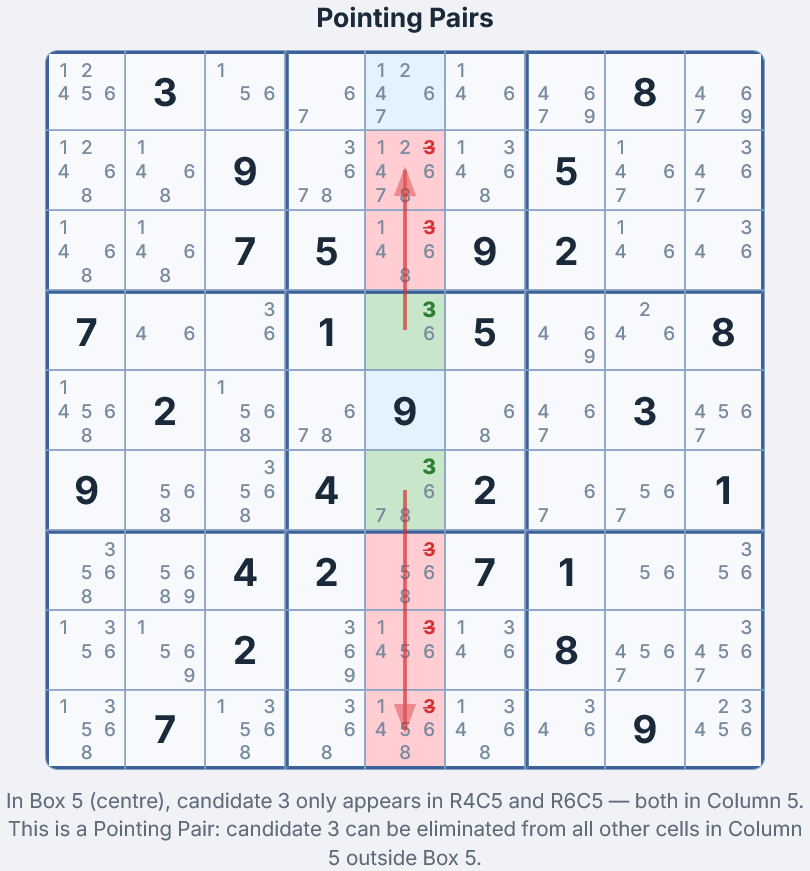
- In Box 5 (the centre box), candidate 3 appears in only two cells: R4C5 and R6C5.
- Both cells are in Column 5.
Since candidate 3 must go somewhere in Box 5, and the only options are R4C5 and R6C5, the digit 3 in Column 5 is locked to Box 5. No other cell in Column 5 can be 3.
Therefore, candidate 3 can be eliminated from every other cell in Column 5 that lies outside Box 5.
Think of a Pointing Pair as a lock: the candidate is locked inside the box along one line. Everything on that line outside the box gets cleared. It doesn’t matter which of the two cells ultimately holds the digit — either way, it stays in the box.
🔎 Step-by-Step Example
Let’s walk through a real Pointing Pair. We’re looking at Box 5 (centre), Column 5, and candidate 3.
Step 1: Scan the box for restricted candidates
In Box 5, check each unsolved candidate. Candidate 3 appears in only two cells:
- R4C5 — candidates {3, 6}
- R6C5 — candidates {3, 6, 7, 8}
No other cell in Box 5 contains candidate 3. Both cells share Column 5.
Step 2: Confirm the Pointing Pair
Since all occurrences of candidate 3 within Box 5 lie in Column 5, this is a valid Pointing Pair. Candidate 3 is “locked” in Box 5 along Column 5.
Step 3: Eliminate along the column
Remove candidate 3 from every cell in Column 5 outside Box 5:
- R2C5 — {1, 2, 3, 4, 6, 7, 8} → {1, 2, 4, 6, 7, 8}
- R3C5 — {1, 3, 4, 6, 8} → {1, 4, 6, 8}
- R7C5 — {3, 5, 6, 8} → {5, 6, 8}
- R8C5 — {1, 3, 4, 5, 6} → {1, 4, 5, 6}
- R9C5 — {1, 3, 4, 5, 6, 8} → {1, 4, 5, 6, 8}
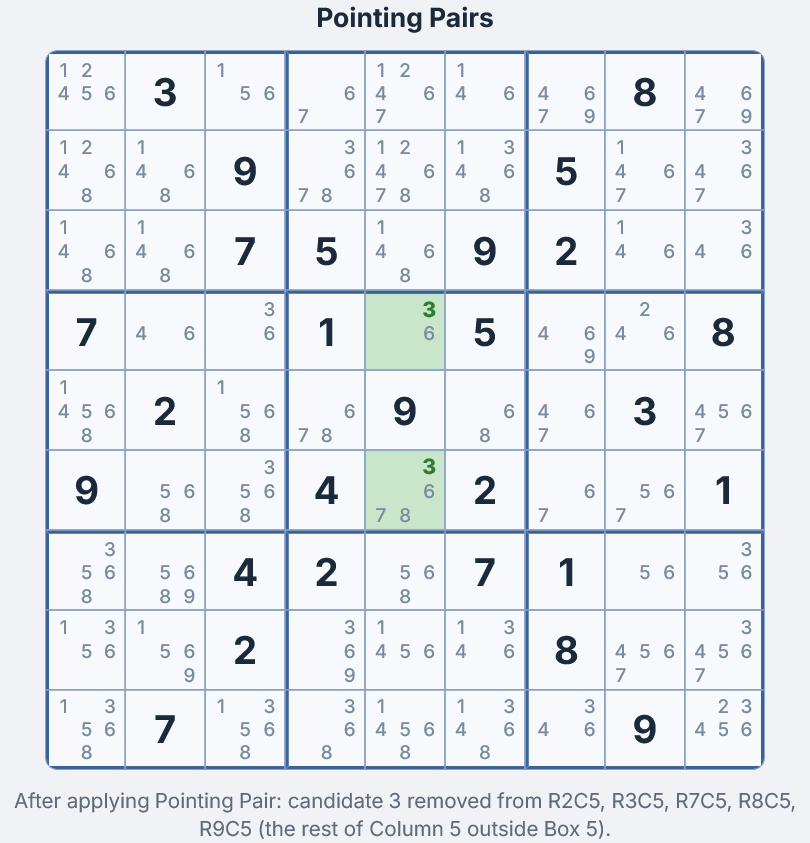
That’s 5 eliminations from a single Pointing Pair — significantly simplifying Column 5.
Step 4: Continue solving
With fewer candidates in Column 5, other techniques become applicable. Reduced candidate lists often expose naked singles, hidden singles, or further pairs that push the solve forward.
Find: A candidate in a box that appears only in cells sharing the same row or column.
Eliminate: That candidate from all other cells in that row or column outside the box.
Result: Fewer candidates, simpler grid, and new opportunities for other techniques.
🕵️ How to Find Pointing Pairs
1. Pick a box and a candidate digit (1–9).
2. Find all cells in that box that contain the candidate.
3. Are they all in the same row? If yes, eliminate the candidate from the rest of that row outside the box.
4. Are they all in the same column? If yes, eliminate the candidate from the rest of that column outside the box.
5. Repeat for every candidate in every box.
Focus on boxes with fewer unsolved cells first — candidates are more likely to be restricted to a single line. Also, look for candidates that appear in only 2 or 3 cells within a box, as these are the most likely Pointing Pair candidates.
🔄 Pointing Pairs vs Box/Line Reduction
Pointing Pairs and Box/Line Reduction (also called Claiming) are two sides of the same coin. They both exploit box-line interactions but from opposite directions.
| Feature | Pointing Pairs | Box/Line Reduction |
|---|---|---|
| Starting point | Look inside a box | Look along a row or column |
| Condition | Candidate in box confined to one line | Candidate in line confined to one box |
| Elimination zone | Rest of the row/column outside the box | Rest of the box outside the row/column |
| Direction | Box → Line | Line → Box |
| Difficulty | Intermediate | Intermediate |
Both techniques are equally important and should be checked together. Many solvers group them under the umbrella term “box-line interactions.”
📌 Row vs Column Pointing Pairs
A Pointing Pair can point along a row or a column. The logic is identical — only the direction of elimination changes.
- Row Pointing Pair: The candidate cells in a box share the same row. Eliminate from the rest of that row outside the box (cells to the left and right).
- Column Pointing Pair: The candidate cells in a box share the same column. Eliminate from the rest of that column outside the box (cells above and below). This is the type we saw in our example.
When a candidate in a box is confined to three cells in the same row or column, the technique still works and is called a Pointing Triple. The elimination rule is the same: remove the candidate from the rest of the row or column outside the box.
⚠️ Common Mistakes to Avoid
1. Eliminating inside the box
The Pointing Pair eliminates candidates outside the box, not inside it. The pair cells themselves keep their candidates. Don’t accidentally remove candidates from other cells within the same box.
2. Missing a third cell in the box
Before declaring a Pointing Pair, confirm that the candidate does not appear in any other cell within the box. If it appears in a cell on a different row/column, the candidate is not confined to one line and the technique doesn’t apply.
3. Confusing with Box/Line Reduction
With Pointing Pairs you start from the box and eliminate along the line. With Box/Line Reduction you start from the line and eliminate inside the box. Make sure you’re eliminating in the right zone.
4. Forgetting to check both rows and columns
Always check both orientations. A candidate could be restricted to a row in one box and to a column in another. Checking only rows means you miss half the opportunities.
📅 When to Look for Pointing Pairs
- Basic techniques: Naked singles, hidden singles, full house.
- Intermediate techniques: Pointing Pairs, Box/Line Reduction, Naked Pairs, Hidden Pairs, Naked Triples.
- Advanced techniques: X-Wing, Swordfish, XY-Wing.
- Expert techniques: XYZ-Wing, W-Wing, Chains, ALS.
Pointing Pairs sit early in the intermediate tier. They should be one of the first techniques you try after exhausting basic singles, often appearing in medium-difficulty puzzles and above.
Puzzles requiring Pointing Pairs are typically rated Medium or harder. Our medium puzzles and hard puzzles are perfect for practising this technique.
🚀 Beyond Pointing Pairs
| Technique | Type | Elimination Zone | Difficulty |
|---|---|---|---|
| Pointing Pairs | Box → Line | Rest of row/column outside box | Intermediate |
| Box/Line Reduction | Line → Box | Rest of box outside row/column | Intermediate |
| Naked Pairs | Pair elimination | Rest of shared unit | Intermediate |
| X-Wing | Row-column pattern | Opposing rows or columns | Advanced |
Master Pointing Pairs and Box/Line Reduction together — they form the foundation of box-line interaction logic that underpins many advanced strategies.
🎯 Practise Pointing Pairs
- Fill in all pencil marks: Pointing Pairs require complete candidate information.
- Scan box by box: For each candidate, check whether it’s restricted to one line.
- Check both directions: Test rows and columns for each box.
- Verify with the solver: Use our Sudoku solver to confirm your findings.
Sudoku Medium
Medium puzzles where Pointing Pairs regularly appear as a key solving step.
▶ Play Medium SudokuSudoku Hard
Challenging grids that require Pointing Pairs alongside other intermediate techniques.
▶ Play Hard SudokuSudoku Solver
Enter your grid and watch the solver find Pointing Pairs automatically.
▶ Open the SolverFrequently Asked Questions
A Pointing Pair occurs when a candidate within a box is restricted to two cells that share the same row or column. Since the candidate must be in one of those cells, it can be eliminated from all other cells in that row or column outside the box.
They are inverse techniques. Pointing Pairs start from a box and eliminate along a row or column. Box/Line Reduction starts from a row or column and eliminates inside a box. Both exploit the same box-line interaction.
Yes. When a candidate in a box is confined to three cells in the same row or column, it is called a Pointing Triple. The logic is identical — the candidate is removed from the rest of that row or column outside the box.
After applying basic techniques like naked singles and hidden singles. Pointing Pairs are an intermediate strategy that appears frequently in medium and hard puzzles.
No. Pointing Pairs work in both rows and columns. When the pair cells share a row, you eliminate from the rest of that row. When they share a column, you eliminate from the rest of that column.