 Sudoku
 If you’ve mastered the X-Wing technique, you’re ready for its bigger sibling: the Swordfish. Where an X-Wing locks a candidate across two rows and two columns, the Swordfish extends that same logic to three rows and three columns — producing even more eliminations in a single step.
The Swordfish is one of the most satisfying advanced techniques to spot in a Sudoku puzzle. It takes practice to see, but once you understand the pattern, it becomes a powerful weapon against hard and expert-level grids.
In this guide we’ll explain exactly what a Swordfish is, walk through the logic, and demonstrate the technique on a real puzzle with before-and-after diagrams.
✅ What Is a Swordfish in Sudoku?
A Swordfish occurs when a candidate digit appears in only 2 or 3 cells in each of three different rows, and all of those cells fall within the same three columns. Because the digit must go in one of these cells in each row, the three rows “lock” the digit into those three columns — and it can be eliminated from every other cell in those three columns.
A Swordfish is a 3×3 fish pattern: a candidate appears in 2–3 positions in each of three base rows, confined to exactly three columns. The candidate can be eliminated from all other cells in those three columns outside the base rows.
The name comes from the fact that the pattern, when visualised with connecting lines, resembles a three-pronged fish shape. It belongs to the “fish” family of techniques alongside X-Wing (2×2) and Jellyfish (4×4).
🧠 How It Works (The Logic)
Think of the Swordfish as three overlapping X-Wings. Here’s the core logic:
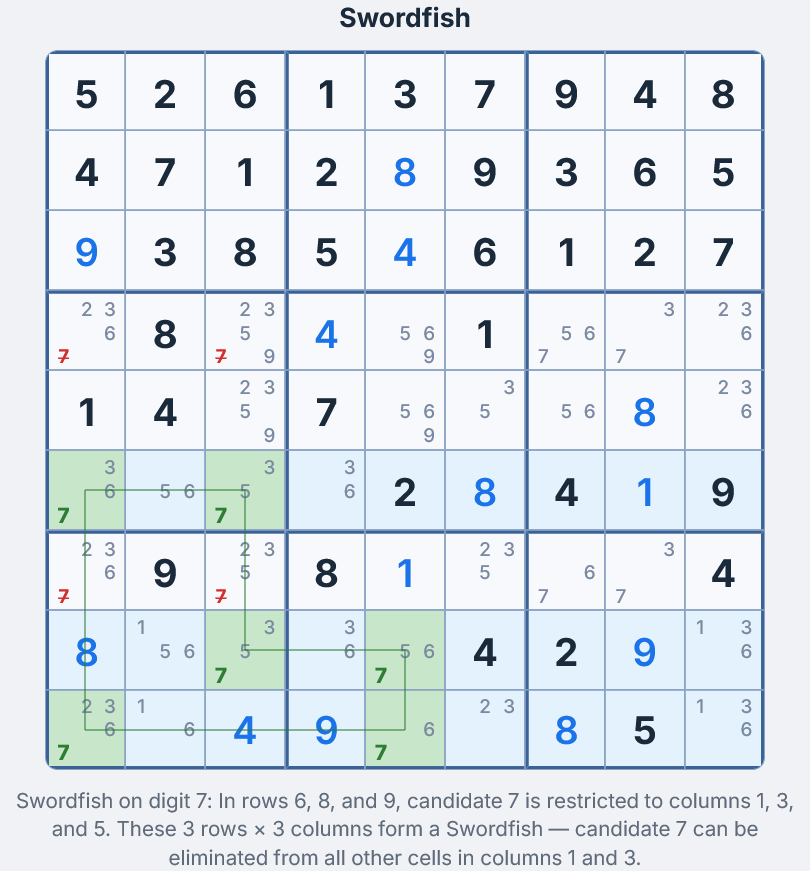
- In Row 6, candidate 7 can only go in columns 1 and 3.
- In Row 8, candidate 7 can only go in columns 3 and 5.
- In Row 9, candidate 7 can only go in columns 1 and 5.
Three rows, all restricted to the same three columns: 1, 3, and 5. The digit 7 must land in exactly one cell per row, and those three placements will each occupy one of the three columns. No matter how the digit is distributed across the rows, every column gets exactly one 7.
Therefore, every other cell in columns 1, 3, and 5 (outside these three rows) cannot contain 7.
The three base rows “consume” one instance of the candidate in each of the three columns. Since each column can only hold the digit once, no other row in those columns can have it.
🔎 Step-by-Step Example
Let’s walk through a real Swordfish. We’re looking at digit 7 across rows 6, 8, and 9 in columns 1, 3, and 5.
Step 1: Identify the pattern rows
Check where candidate 7 appears in each row:
- Row 6 — candidate 7 in R6C1 {3,6,7} and R6C3 {3,5,7}
- Row 8 — candidate 7 in R8C3 {3,5,7} and R8C5 {5,6,7}
- Row 9 — candidate 7 in R9C1 {2,3,6,7} and R9C5 {6,7}
All candidate-7 positions are confined to columns 1, 3, and 5 — exactly three columns.
Step 2: Confirm the Swordfish
Three rows, three columns, candidate 7 restricted to 2 cells per row, all within the same column set. This is a valid Swordfish pattern.
Step 3: Eliminate from the columns
Remove candidate 7 from every cell in columns 1, 3, and 5 that is not in rows 6, 8, or 9:
- R4C1 — {2,3,6,7} → {2,3,6}
- R4C3 — {2,3,5,7,9} → {2,3,5,9}
- R7C1 — {2,3,6,7} → {2,3,6}
- R7C3 — {2,3,5,7} → {2,3,5}
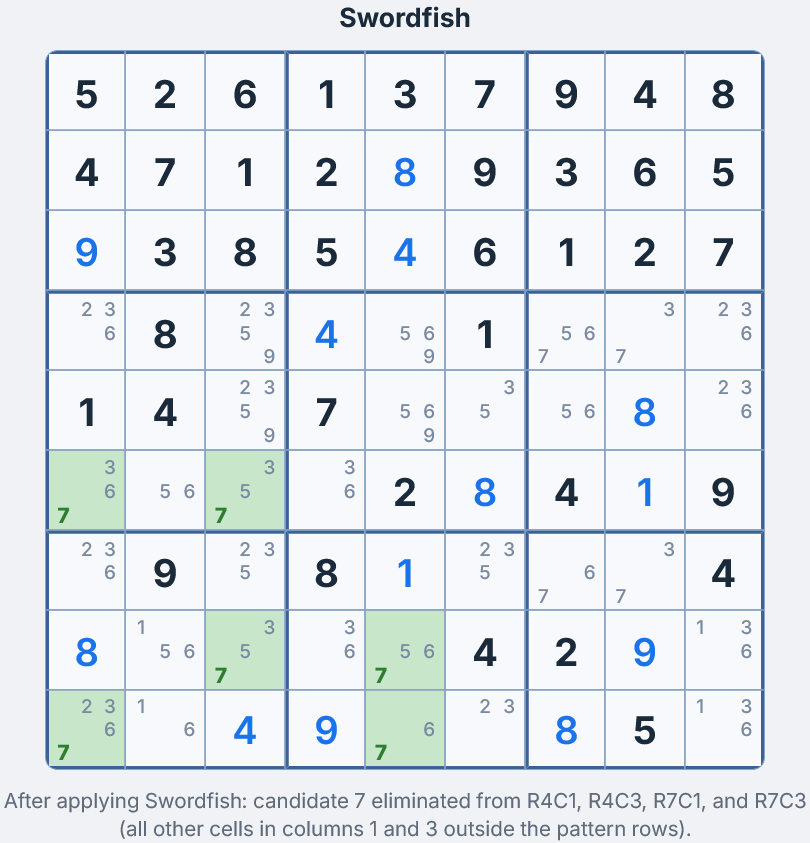
That’s 4 eliminations from a single Swordfish — clearing candidate 7 from cells outside the pattern rows in columns 1 and 3.
Step 4: Continue solving
With fewer candidates in those columns, new singles, pairs, or other patterns may emerge. In this case, R7C3 is reduced to just {2,3,5}, potentially enabling further progress.
Find: A candidate that appears in 2–3 cells per row across three rows, confined to exactly three columns.
Eliminate: That candidate from all other cells in those three columns outside the pattern rows.
Result: Fewer candidates in the target columns, opening up new solving opportunities.
🕵️ How to Find a Swordfish
1. Pick a candidate digit (1–9).
2. For each row, note which columns contain that candidate. Focus on rows with only 2 or 3 positions.
3. Look for three rows whose column positions are all drawn from the same set of exactly three columns.
4. If found, eliminate the candidate from all other cells in those three columns outside the three rows.
5. Repeat for every digit.
Start by listing rows where the candidate appears in exactly 2 cells — these are the easiest rows to pair up into a Swordfish. If you find two such rows sharing two columns, look for a third row that includes those columns (possibly adding a third) to form the full pattern. This is easier than searching three rows simultaneously.
🔄 Swordfish vs X-Wing
The Swordfish is the natural extension of the X-Wing. They belong to the same “fish” family and use identical logic at different scales.
| Feature | X-Wing | Swordfish |
|---|---|---|
| Base rows | 2 | 3 |
| Columns involved | 2 | 3 |
| Cells per row | Exactly 2 | 2 or 3 |
| Elimination scope | Other cells in 2 columns | Other cells in 3 columns |
| Difficulty | Advanced | Advanced |
| Frequency | Moderate (hard puzzles) | Rare (expert puzzles) |
Once you can spot X-Wings confidently, the leap to Swordfish is mostly about scanning three rows at a time instead of two. The underlying principle — restricted positions locking a candidate into specific columns — is the same.
📌 Row-Based vs Column-Based Swordfish
A Swordfish can use either rows or columns as its base. The logic is identical — only the orientation changes.
- Row-based Swordfish: Three base rows with the candidate confined to three columns. Eliminate from the rest of those three columns. This is the type we saw in our example.
- Column-based Swordfish: Three base columns with the candidate confined to three rows. Eliminate from the rest of those three rows.
Not every row in a Swordfish needs to have the candidate in all three columns. An “incomplete” Swordfish has the candidate in only 2 of the 3 columns in some rows (as in our example, where each row has exactly 2 positions). The pattern is still valid as long as the union of all positions spans exactly three columns.
⚠️ Common Mistakes to Avoid
1. Pattern spanning more than 3 columns
If the candidate positions across three rows span four or more columns, it’s not a Swordfish. Verify that the union of all column positions equals exactly three before applying any eliminations.
2. Eliminating inside the pattern rows
Only eliminate the candidate from cells in the three Swordfish columns that are outside the three base rows. Never remove candidates from cells within the pattern rows themselves.
3. Forgetting the second orientation
If no row-based Swordfish exists, remember to check column-based patterns as well. Checking only one orientation means missing half the possible Swordfish patterns.
4. Confusing with X-Wing
An X-Wing uses 2 rows and 2 columns; a Swordfish uses 3. Make sure you have exactly three rows with positions spanning exactly three columns — not two (X-Wing) or four (Jellyfish).
📅 When to Look for Swordfish
- Basic techniques: Naked singles, hidden singles, full house.
- Intermediate techniques: Pointing Pairs, Box/Line Reduction, Naked Pairs, Hidden Pairs.
- Advanced techniques: X-Wing, Swordfish, XY-Wing.
- Expert techniques: Jellyfish, XYZ-Wing, W-Wing, Chains, ALS.
Swordfish sits in the advanced tier. Try X-Wing first — only look for Swordfish when X-Wing and other simpler techniques have been exhausted. In practice, Swordfish appears primarily in hard and expert-level puzzles.
Puzzles requiring a Swordfish are typically rated Hard or Expert. Our hard puzzles are perfect for practising advanced fish techniques.
🚀 Beyond Swordfish
| Technique | Size | Elimination Scope | Difficulty |
|---|---|---|---|
| X-Wing | 2 rows × 2 cols | Other cells in 2 columns | Advanced |
| Swordfish | 3 rows × 3 cols | Other cells in 3 columns | Advanced |
| Jellyfish | 4 rows × 4 cols | Other cells in 4 columns | Expert |
| XY-Wing | 3 bi-value cells | Cells seeing both wing cells | Advanced |
Master the Swordfish and you’ll have unlocked the full fish family from X-Wing to Jellyfish — a progression that applies the same logical principle at increasing scale.
🎯 Practise Swordfish
- Fill in all pencil marks: Swordfish requires complete candidate information.
- Focus on digits with few candidates: If a digit appears in only 2–3 cells per row across multiple rows, investigate further.
- Check both orientations: Test rows first, then columns.
- Verify with the solver: Use our Sudoku solver to confirm your findings.
Sudoku Hard
Hard puzzles where advanced techniques like Swordfish may appear as key solving steps.
▶ Play Hard SudokuSudoku Solver
Enter your grid and watch the solver find advanced techniques including Swordfish.
▶ Open the SolverFrequently Asked Questions
A Swordfish is an advanced technique. When a candidate appears in only 2 or 3 cells in each of three rows, and those cells fall within the same three columns, the candidate can be eliminated from every other cell in those three columns outside the pattern rows.
An X-Wing uses 2 rows and 2 columns, while a Swordfish uses 3 rows and 3 columns. Both follow the same logic, but Swordfish covers a larger area and can produce more eliminations.
After exhausting basic and intermediate techniques plus X-Wing. Swordfish is an advanced technique found in hard and expert-level puzzles.
Yes. A Swordfish can be row-based (3 base rows, eliminate from columns) or column-based (3 base columns, eliminate from rows). The logic is identical in both orientations.
The next step in the fish family is the Jellyfish, which extends the pattern to 4 rows and 4 columns. Beyond fish patterns, techniques like XY-Wing, W-Wing, and chains offer additional advanced solving power.