 Sudoku
 You’ve mastered naked pairs, hidden pairs, and even the X-Wing. Yet some grids still refuse to budge, packed with pencil marks that basic and intermediate techniques can’t crack. Sound familiar?
Enter the XY-Wing — also known as the Y-Wing — an advanced elimination strategy that connects three bi-value cells in a logical chain. Once you see how it works, an entire class of stubborn puzzles suddenly becomes solvable.
In this guide we’ll explain exactly what an XY-Wing is, walk through the logic behind it, and demonstrate the technique on a real puzzle with before-and-after diagrams.
✅ What Is an XY-Wing in Sudoku?
The XY-Wing (sometimes written Y-Wing) is an advanced candidate-elimination technique that uses exactly three bi-value cells. Each cell contains precisely two candidates, and they share digits in a specific pattern.
An XY-Wing consists of a pivot cell with candidates {X, Y} and two pincer cells: one with {X, Z} and one with {Y, Z}. The pivot must see both pincers. Any cell that can see both pincers can have candidate Z eliminated.
The name comes from the three candidate pairs. The pivot holds X and Y, while the pincers each contribute the elimination digit Z. Together, they form a “wing” with the pivot at the centre.
🧠 How the XY-Wing Works (The Logic)
The reasoning is surprisingly clean. Consider three bi-value cells on a real grid:
- Pivot R1C1 has candidates {4, 5}.
- Pincer R1C9 has candidates {5, 7} — shares digit 5 with the pivot.
- Pincer R2C3 has candidates {4, 7} — shares digit 4 with the pivot.
The pivot can only be 4 or 5. Let’s trace both possibilities:
- If the pivot is 4: Pincer R1C9 still has {5, 7}, unaffected. But Pincer R2C3 loses its 4 (same box), so it must be 7.
- If the pivot is 5: Pincer R2C3 still has {4, 7}, unaffected. But Pincer R1C9 loses its 5 (same row), so it must be 7.
Either way, at least one pincer is always 7. That means any cell that can see both pincers can never be 7 — it would conflict with whichever pincer holds the 7.
Think of the XY-Wing as a logical fork: no matter which way the pivot goes, the elimination digit Z is forced into one of the two pincers. Cells seeing both pincers are always “caught in the crossfire.”
🔎 Step-by-Step Example
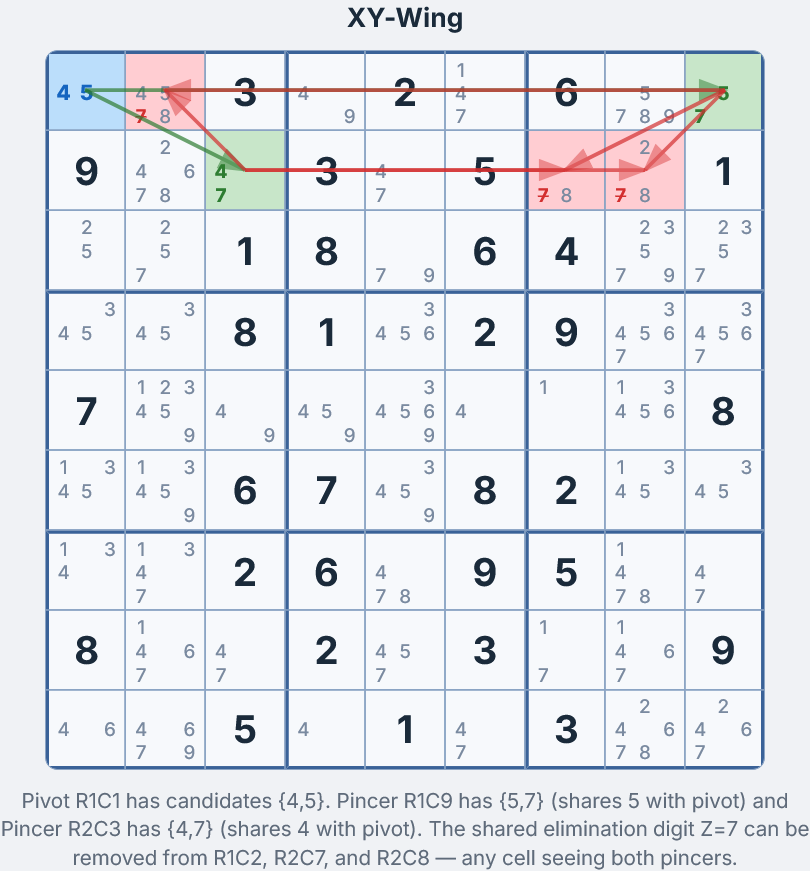
Let’s walk through a real XY-Wing. The pivot sits at R1C1 in Box 1, one pincer is at R1C9 (connected by Row 1), and the other pincer is at R2C3 (connected by Box 1). The elimination digit is Z = 7.
Step 1: Identify the three cells
- Pivot R1C1: candidates {4, 5} — sees both pincers.
- Pincer R1C9: candidates {5, 7} — shares 5 with pivot (same row).
- Pincer R2C3: candidates {4, 7} — shares 4 with pivot (same box).
Step 2: Confirm the pattern
Check the requirements: all three cells are bi-value ✔, the pivot sees both pincers ✔, each pincer shares exactly one digit with the pivot ✔, and the “other” digit in each pincer is the same (Z = 7) ✔.
Step 3: Find the elimination targets
Which cells can see both pincers (R1C9 and R2C3) and contain candidate 7?
- R1C2 — {4, 5, 7, 8}: sees R1C9 (same row) and R2C3 (same box). Remove 7 → {4, 5, 8}.
- R2C7 — {7, 8}: sees R1C9 (same box) and R2C3 (same row). Remove 7 → {8} — solved!
- R2C8 — {2, 7, 8}: sees R1C9 (same box) and R2C3 (same row). Remove 7 → {2, 8}.
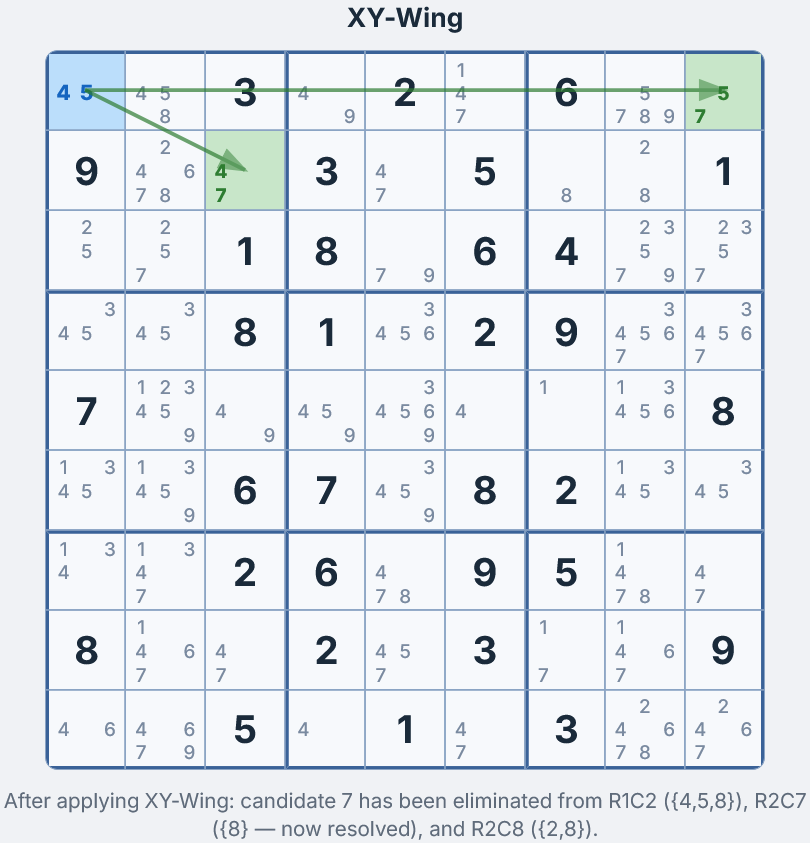
That’s 3 eliminations from a single XY-Wing, and R2C7 is instantly resolved as 8!
Step 4: Continue solving
Resolving R2C7 as 8 creates a cascade: R2C8 becomes {2}, further constraining the grid. One well-spotted XY-Wing can unlock an entire puzzle.
Find: A pivot {X, Y} that sees two pincers — one with {X, Z} and one with {Y, Z}.
Eliminate: Candidate Z from any cell that sees both pincers.
Result: Fewer candidates, potential naked singles, and a simpler grid.
🕵️ How to Find an XY-Wing
1. Scan the grid for bi-value cells — cells with exactly two candidates.
2. Pick a bi-value cell as a potential pivot {X, Y}.
3. Look at every bi-value cell the pivot can see. Does one contain X and some digit Z?
4. Look again: does a different bi-value cell the pivot can see contain Y and the same Z?
5. If yes, eliminate Z from any cell that sees both pincers.
Start with bi-value cells in busy areas of the grid — where rows, columns, and boxes intersect with many unsolved cells. XY-Wings are more likely to produce eliminations when the pincers span different units.
🔄 XY-Wing vs X-Wing
Despite the similar names, XY-Wing and X-Wing are completely different techniques.
| Feature | X-Wing | XY-Wing |
|---|---|---|
| Cells involved | 4 cells in a rectangle | 3 bi-value cells (pivot + 2 pincers) |
| Shape | Rectangle across 2 rows & 2 columns | Wing (pivot at centre, pincers at tips) |
| Candidate focus | One candidate across rows/columns | Three linked digits (X, Y, Z) |
| Elimination | Removes one digit from entire rows or columns | Removes Z from cells seeing both pincers |
| Bi-value required? | No | Yes — all three cells must be bi-value |
Think of X-Wing as a row/column pattern and XY-Wing as a candidate-chain pattern. Both are advanced, but they solve different types of bottlenecks.
📌 How the Pivot Connects to Pincers
The pivot must “see” both pincers, meaning it shares a row, column, or box with each. Common connectivity patterns:
- Row + Column: Pivot connects to one pincer by row, the other by column — forming an L-shape.
- Row + Box: One pincer in the same row, another in the same box (as in our example above).
- Column + Box: One pincer in the same column, another in the same box.
- Box + Box: In rare cases, both pincers share the pivot’s box (all three cells in the same box).
A common misconception: the pincers do not need to see each other. They only need to see the pivot. Eliminations happen in cells that see both pincers — the pivot itself is not part of the elimination zone.
⚠️ Common Mistakes to Avoid
1. Using cells that aren’t bi-value
All three cells (pivot and both pincers) must have exactly two candidates. A cell with three or more candidates cannot participate in an XY-Wing.
2. Getting the shared digits wrong
Each pincer must share exactly one digit with the pivot, and the two shared digits must be different. The “leftover” digit in each pincer must be the same — that’s your Z.
3. Eliminating from the wrong cells
You can only eliminate Z from cells that see both pincers. Seeing just one pincer is not enough. Double-check the row, column, and box relationships.
4. Confusing XY-Wing with X-Wing
They look nothing alike in practice. X-Wing is a rectangle; XY-Wing is a chain of three bi-value cells.
📅 When to Look for XY-Wings
- Basic techniques: Naked Singles, Hidden Singles, Full House.
- Intermediate techniques: Naked Pairs, Hidden Pairs, Naked Triples, Pointing Pairs, Box/Line Reduction.
- Advanced techniques: X-Wing, Swordfish, XY-Wing.
- Expert techniques: XYZ-Wing, W-Wing, Chains, Almost Locked Sets.
Puzzles requiring XY-Wing are typically rated Hard or Expert. Our hard puzzles are great places to practice this technique.
🚀 Beyond XY-Wing: XYZ-Wing & W-Wing
| Technique | Cells | Pivot Candidates | Difficulty |
|---|---|---|---|
| XY-Wing | 3 (bi-value) | 2 (X, Y) | Advanced |
| XYZ-Wing | 3 (pivot has 3) | 3 (X, Y, Z) | Advanced+ |
| W-Wing | 2 + linking cell | 2 (same pair) | Expert |
Master the XY-Wing first. The logical reasoning — tracing what happens when the pivot is X versus Y — transfers directly to its more complex cousins.
XY-Wing, XYZ-Wing, and WXYZ-Wing form a family of increasing complexity. Each adds one more candidate to the pivot, changing the elimination rules slightly. Start with XY-Wing and build from there.
🎯 Practice XY-Wings
- Fill in all pencil marks: XY-Wing depends on knowing every candidate in every cell.
- Scan for bi-value cells: Cells with exactly two candidates are your building blocks.
- Check connections: For each bi-value cell, ask “can two other bi-value cells I can see form a wing?”
- Verify with the solver: Use our Sudoku solver to confirm your findings.
Sudoku Hard
Hard puzzles where XY-Wing and other advanced techniques are regularly needed.
▶ Play Hard SudokuSudoku Medium
Intermediate puzzles to practise identifying bi-value cells before tackling XY-Wing.
▶ Play Medium SudokuFrequently Asked Questions
An XY-Wing uses three bi-value cells: a pivot with {X, Y} and two pincers with {X, Z} and {Y, Z}. The pivot sees both pincers, and any cell seeing both pincers can have candidate Z eliminated.
X-Wing uses four cells in a rectangle to eliminate a candidate from rows or columns. XY-Wing uses three bi-value cells linked through candidate pairs. They are completely different techniques.
Scan for bi-value cells. Pick one as a pivot {X, Y}, then look for two other bi-value cells it can see — one with {X, Z} and one with {Y, Z}. Eliminate Z from cells seeing both pincers.
The pivot must be X or Y. If it’s X, the {Y, Z} pincer must be Z. If it’s Y, the {X, Z} pincer must be Z. Either way, one pincer is always Z, so cells seeing both pincers can never be Z.
No. Each pincer must see the pivot, but the pincers do not need to see each other. Eliminations happen in cells that see both pincers.