 Sudoku
 If you’ve ever looked at an empty Sudoku cell and realized only one digit could possibly fit there, you’ve already used a naked single. It’s the most intuitive solving technique — no tricks, no complex logic, just the simple fact that when every other digit is accounted for, only one remains.
Unlike hidden singles, where the key digit is buried among other candidates, a naked single is completely exposed — the cell has exactly one candidate. That’s why it’s called “naked”: the answer is right there in plain sight.
In this guide, we explain exactly what naked singles are, walk through a real example with before-and-after diagrams, and show you the most efficient ways to find them in your puzzles.
✅ What Are Naked Singles in Sudoku?
A naked single (also called a sole candidate) is the simplest possible Sudoku technique. It occurs when an empty cell has only one candidate remaining after you account for all the digits in its row, column, and box.
A naked single is a cell where eight of the nine digits (1–9) are already present in the cell’s row, column, or box. Since only one digit is missing, that digit must go in the cell. No other possibilities exist.
The word “naked” means the answer is fully exposed. There’s nothing hiding it — the cell contains exactly one candidate, and that’s the answer. This contrasts with a hidden single, where the key digit is hidden among other candidates in the cell.
Naked singles are the N = 1 case of the naked subset family. One candidate in one cell. As N increases to 2 and 3, you get naked pairs and naked triples — but the naked single is where it all begins.
🧠 How Naked Singles Work (The Logic)
Every empty cell in a Sudoku puzzle must contain exactly one of the digits 1–9. Three constraints restrict which digits are available:
- Row constraint: No digit can repeat in a row.
- Column constraint: No digit can repeat in a column.
- Box constraint: No digit can repeat in a 3×3 box.
If you check all three constraints and find that eight of the nine digits are already used, only one digit remains. That’s a naked single. Let’s see how this works with a concrete example.
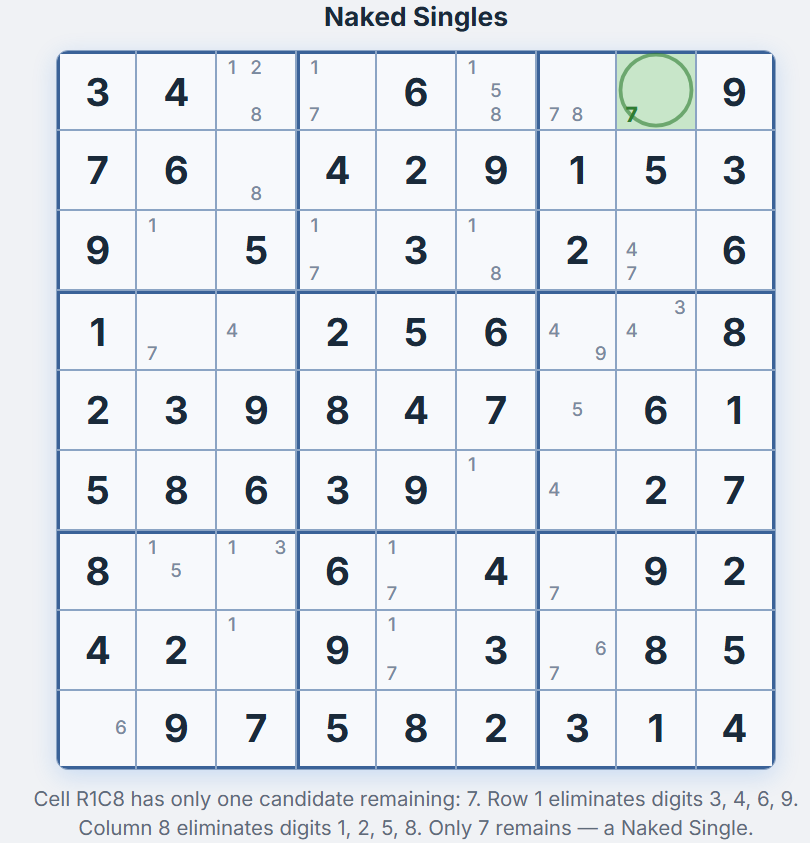
Consider cell R1C8 (Row 1, Column 8). We check:
- Row 1 already contains: 3, 4, 6, 9 — eliminating these four digits.
- Column 8 already contains: 1, 2, 5, 8 — eliminating these four digits.
- Together, that accounts for digits 1, 2, 3, 4, 5, 6, 8, and 9.
Only 7 is left. R1C8 must be 7 — it’s a naked single.
You don’t need all three constraints to independently contribute. Sometimes the row alone eliminates eight digits; sometimes it takes a combination of row, column, and box. What matters is the total: if all other digits are blocked, the cell is a naked single.
🔎 Step-by-Step Example
Let’s walk through a naked single on a real puzzle. We’re looking at cell R1C8, which has only one candidate: 7.
Step 1: Identify the Naked Single
After filling in all pencil marks (candidates) across the grid, scan for any cell with exactly one candidate:
- R1C8 has only one candidate: {7}.
- Row 1 eliminates: 3, 4, 6, 9.
- Column 8 eliminates: 1, 2, 5, 8.
- Only the digit 7 survives — this is a naked single.
Step 2: Place the Digit
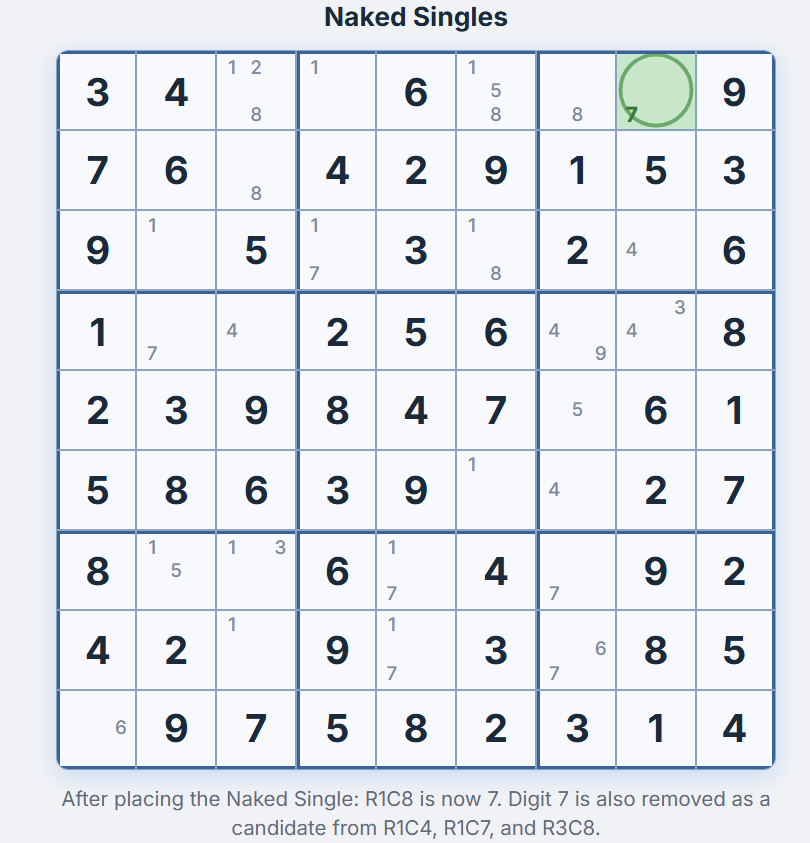
Since 7 is the only candidate, place it in R1C8. Then remove 7 as a candidate from all other cells in the same row, column, and box:
- R1C4: {1, 7} → {1} (7 removed from Row 1)
- R1C7: {7, 8} → {8} (7 removed from Row 1)
- R3C8: {4, 7} → {4} (7 removed from Column 8)
Step 3: Follow the Cascade
Placing one naked single often creates more. After setting R1C8 = 7:
- R1C4 now has only {1} → another naked single!
- R1C7 now has only {8} → another naked single!
- R3C8 now has only {4} → another naked single!
This kind of cascade is what makes naked singles so powerful. One placement can trigger a chain reaction that solves large portions of the puzzle.
Find: A cell with exactly one candidate remaining.
Place: That digit in the cell.
Update: Remove the digit from all peers (same row, column, and box).
Result: A solved cell, and potentially more naked singles in the updated grid.
🕵️ How to Spot Naked Singles in Your Puzzle
There are two main approaches to finding naked singles — use whichever suits your style:
1. Fill in all candidates for every empty cell.
2. Scan the grid for any cell with exactly one candidate.
3. Place the digit, update candidates in the affected row/column/box.
4. Repeat — each placement may create new naked singles.
1. Pick an empty cell.
2. Check which digits are already in its row, column, and box.
3. If only one digit is missing from those combined constraints, you’ve found a naked single.
4. Place the digit and move on.
The pencil-mark method is more systematic and catches everything, but it requires more upfront work. The cell-by-cell approach is faster for cells with many filled neighbours, which is why experienced players start with the most constrained areas of the grid.
Look for cells at the intersection of busy rows, columns, and boxes. The more givens around a cell, the more candidates are eliminated, and the more likely it is to be a naked single. Cells in nearly complete rows or columns are prime candidates.
🔄 Naked Singles & the Three Constraints
A naked single is created when the three Sudoku constraints — row, column, and box — collectively eliminate eight of the nine possible digits from a cell:
- All from the row: Sometimes a row has eight filled cells, leaving only one empty cell with one digit. This is the most obvious naked single.
- All from the column: Same idea, but vertically. A nearly complete column forces the last cell.
- Combined effort: Most commonly, the row eliminates some digits, the column eliminates others, and the box eliminates the rest. No single constraint does all the work, but together they leave exactly one candidate.
In our example, Row 1 eliminates {3, 4, 6, 9} and Column 8 eliminates {1, 2, 5, 8}. Between them, eight digits are gone and only 7 remains. The box constraint is redundant here — row and column did all the work — but that’s fine. You only need enough constraints to narrow it down to one.
When a row, column, or box has exactly one empty cell, that cell must contain the one missing digit. This special case of a naked single is sometimes called a full house — the simplest possible deduction in Sudoku.
⚠️ Common Mistakes to Avoid
Naked singles are straightforward, but beginners sometimes trip on these points:
1. Forgetting to Check All Three Constraints
Don’t just check the row. Always verify the column and box too. A digit might appear available from two constraints but blocked by the third.
2. Not Updating Candidates After Placement
After placing a naked single, remember to remove that digit from all peers — every other cell in the same row, column, and box. Skipping this step means you’ll miss cascading naked singles.
3. Overlooking Naked Singles in Favour of Complex Techniques
Many players jump to advanced strategies when there are still naked singles on the board. Always exhaust the basics first. Hidden and naked singles should be your first check after every placement.
4. Miscounting Candidates
Counting through nine digits across three units is error-prone. If you’re making mistakes, use pencil marks — they make naked singles visually obvious (any cell with a single pencil mark is one).
After placing any digit — whether from a naked single, hidden single, or advanced technique — immediately re-scan the affected row, column, and box for new naked singles. The cascade effect is the fastest way to progress through a puzzle.
📅 When to Look for Naked Singles
Naked singles sit at the very bottom of the Sudoku difficulty hierarchy — they are the first technique to apply and the last to stop applying:
- Foundation techniques: Naked singles, hidden singles, full house.
- Intermediate techniques: Naked pairs, hidden pairs, naked triples, hidden triples, pointing pairs, box/line reduction.
- Advanced techniques: X-Wing, Swordfish, XY-Wing.
- Expert techniques: Jellyfish, chains, Almost Locked Sets.
You should always check for naked singles after every deduction, no matter how advanced. Even after applying an X-Wing or Swordfish, the eliminations it produces may create new naked singles that crack the puzzle open.
Every Sudoku puzzle uses naked singles — they appear at all difficulty levels. Our easy puzzles can typically be solved with naked and hidden singles alone, while medium and hard puzzles require additional techniques between rounds of single-scanning.
🚀 Naked Singles vs Hidden Singles
Naked singles and hidden singles are the two foundational placement techniques in Sudoku. They’re complementary approaches that together find every basic placement:
| Technique | What You Look At | Condition | Result | Difficulty |
|---|---|---|---|---|
| Naked single | A cell | Cell has only 1 candidate | Place that candidate | Easiest |
| Hidden single | A unit (row/col/box) | A digit fits in only 1 cell | Place that digit | Easy |
| Naked pair | A unit | 2 cells share exactly 2 candidates | Eliminate those candidates elsewhere | Intermediate |
| Hidden pair | A unit | 2 digits confined to 2 cells | Eliminate other candidates from those cells | Intermediate |
Think of it this way: naked singles ask “what can go in this cell?” while hidden singles ask “where can this digit go in this unit?” Both questions lead to placements, but they approach the puzzle from opposite directions.
In a fully pencil-marked grid, every hidden single will eventually become a naked single as surrounding cells are solved and candidates are eliminated. Using both approaches simultaneously ensures you find every available placement as quickly as possible.
🎯 Practice Naked Singles
The best way to master naked singles is to practice on real puzzles. Here are some tips:
- Use pencil marks: Fill in all candidates so naked singles jump out visually — any cell with a single pencil mark is one. Our note mode makes this easy.
- Start with easy puzzles: Easy puzzles rely almost entirely on naked and hidden singles, making them the perfect training ground.
- Focus on busy areas: Cells surrounded by many filled neighbours are the most likely to be naked singles. Start there.
- Check with the solver: Use our Sudoku solver to verify your work and see which technique each step uses.
Sudoku Easy
Puzzles designed to be solved primarily with naked and hidden singles. The perfect place to practice this technique.
▶ Play Easy SudokuClassic Sudoku
Standard 9×9 puzzles at every difficulty level. Naked singles are your fundamental tool in every game.
▶ Play Classic SudokuSudoku Solver
Enter any puzzle and watch the solver find naked singles and other techniques automatically, step by step.
▶ Open the SolverFrequently Asked Questions
A naked single is a cell that has only one candidate remaining after eliminating all other digits using row, column, and box constraints. Since no other digit can go there, that lone candidate must be the answer. It is the simplest and most fundamental Sudoku solving technique.
A naked single is a cell with only one candidate — the digit is plainly visible. A hidden single is a cell where one candidate appears nowhere else in its row, column, or box, even though the cell may have multiple candidates. Naked singles are found by looking at cells; hidden singles are found by looking at where digits can go within a unit.
Fill in all pencil marks (candidates) for every empty cell. Any cell left with exactly one candidate is a naked single. Alternatively, pick an empty cell and count which digits from 1–9 are already present in that cell’s row, column, and box. If eight of the nine digits are accounted for, the remaining digit is a naked single.
Naked singles are the most basic beginner technique — the very first strategy every Sudoku solver learns. Along with hidden singles, they form the foundation of Sudoku solving. Most easy puzzles can be solved entirely with naked and hidden singles.
It is called “naked” because the digit is fully exposed — there is only one candidate in the cell, with nothing hiding it. This contrasts with a “hidden” single, where the key digit is obscured among other candidates in the cell. The terms “naked” and “hidden” are used throughout Sudoku for pairs, triples, and quads as well.