 Sudoku
Killer Sudoku
Practice row, column, and box totals with cage sums in a full puzzle.
Play Killer SudokuA complete guide to the Killer Sudoku rule of 45: how it works, when to use innies and outies, and how to turn cage totals into real placements.
Written by Brian Hamilton and Karan Hamilton.
Brian and Karan are the puzzle lovers and game makers behind Sudoku Online Puzzles. You can learn more on the About page.
Guides are reviewed for clarity, accuracy, and usefulness for solvers. See our editorial standards, puzzle testing process, or send a correction.
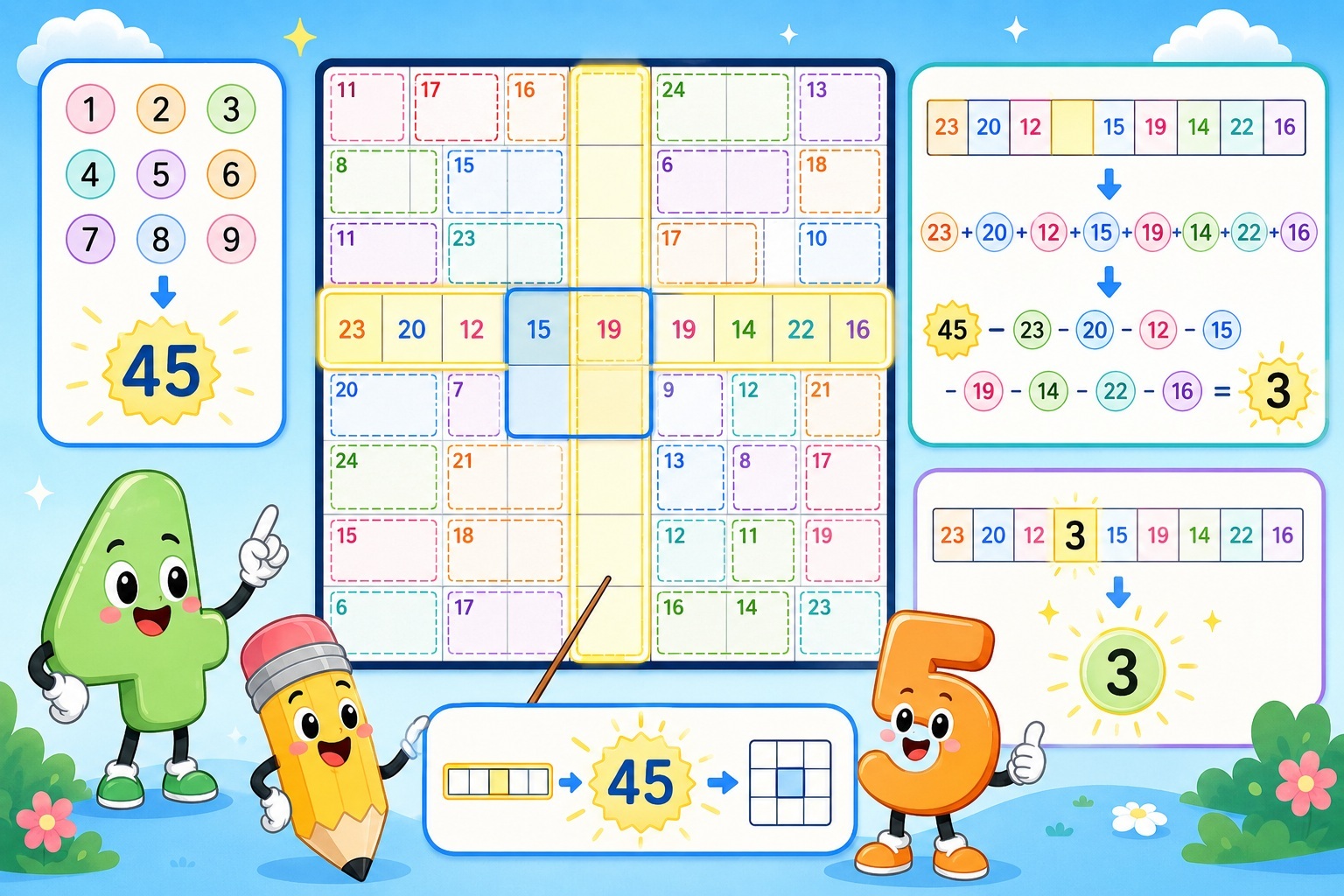
Start with the Rules of Killer Sudoku guide if you want the full cage, sum, and no-repeat explanation before using this strategy.
A complete guide to the Killer Sudoku rule of 45: how it works, when to use innies and outies, and how to turn cage totals into real placements.
The Rule of 45 in Sudoku means every row, column, and 3x3 box totals 45. In Killer Sudoku, subtract cage totals from 45 to find innies, outies, missing cells, and smaller sums that restrict candidates.
The rule of 45 makes the most sense when you test it on real cages. Keep a Killer Sudoku grid open, then try one calculation at a time before moving to the next section.
Practice row, column, and box totals with cage sums in a full puzzle.
Play Killer Sudoku
Use a fresh daily grid to build a repeatable rule-of-45 habit.
Play Daily Killer
Check a cage calculation or study the next logical step when a puzzle stalls.
Open Killer SolverThe Rule of 45 is one of the first serious Killer Sudoku techniques because it turns the ordinary Sudoku rule into arithmetic. Every row, every column, and every 3x3 box must contain 1 to 9 exactly once, so every complete house totals 45.
Killer Sudoku gives you cage totals. When cages line up with a house, you can compare the cage totals with 45. Any difference must belong to cells that are not neatly inside the counted area. That small difference is often easier to solve than the original cage.
This is why the Rule of 45 is not a trick for one rare puzzle shape. It is a general accounting method. You decide which house you are counting, add the relevant cage clues, compare with 45, then interpret the difference.
Use this checklist whenever you see cages crossing a row, column, or box:
House total = 45. Cage total inside the house plus innies must equal cage total including outies. In plain language: add the cages you can see, compare them with 45, and the gap tells you the extra cell or missing cell.
If cages fully cover a box and the totals add to 45, the box is accounted for. If they total 41 with one uncovered cell inside the box, that uncovered cell is 4. If cages mostly inside the box total 52 because one cage cell sticks outside, the outside cell is 7.
An innie is a cell inside the house you are counting that was not included in the cage totals. If the counted cages total less than 45, the missing amount belongs to the innie cells.
An outie is a cell outside the house that belongs to one of the cages you added. If the cage totals are greater than 45, the excess belongs to the outie cells.
The words sound technical, but the idea is simple: the box, row, or column must be 45. Anything extra or missing has to be paid for by cells crossing the boundary.
The cleanest Rule of 45 moves solve one cell immediately. Suppose a 3x3 box has cages contained inside it that total 39, and there is exactly one uncovered cell in the box. That cell must be 6 because 45 - 39 = 6.
Now flip the shape. Suppose the cages mostly inside a box total 51, but one cell from one of those cages sticks out of the box. The box itself still totals 45, so the outside cell must be 6 because 51 - 45 = 6.
These are the examples to look for early. A single innie or single outie is precise, fast, and usually creates a wave of ordinary Sudoku eliminations.
Many real puzzles do not give a single leftover cell. They give a two-cell sum or a three-cell sum. That is still useful, especially when the cells share a row, column, box, or cage.
If two innies inside a box total 10, they cannot be 5+5 because Sudoku houses cannot repeat digits. They could be 1+9, 2+8, 3+7, or 4+6 before other restrictions. If the same two cells sit in a row that already contains 9 and 8, the possible pairs shrink quickly.
Do not ignore multi-cell Rule of 45 results just because they are not placements. Treat them as small cages you discovered yourself. They can form naked pairs, hidden pairs, locked candidates, and useful cage-combination limits.
Boxes are usually the easiest place to start because Killer cages often stay near box boundaries. Rows and columns are just as powerful once the grid has more digits filled in.
In a row, add every cage segment that lies completely in the row. If one cage crosses out of the row, decide whether the outside part is an outie or whether you should count a smaller set and find an innie. The same process works down a column.
Rows and columns become especially strong near the middle of a puzzle. Solved digits reduce cage combinations, and the Rule of 45 can turn a vague cage into a direct two-cell sum.
The Rule of 45 scales. Two complete houses total 90. Three complete houses total 135. If you count two boxes together and the cage totals around them leave only one or two crossing cells, the arithmetic can be stronger than counting either box alone.
For example, two adjacent boxes total 90. If the cages covering those boxes total 97 and exactly one cell sticks outside the two-box area, that outie is 7. If the cages total 84 and two cells inside the area are not covered, those two innies total 6.
Multi-house counting is useful when a single box has too many loose ends. Zoom out, count a bigger region, and see whether the number of crossing cells gets smaller.
The Rule of 45 rarely works alone for the whole puzzle. Its real strength is that it creates smaller cage problems. A two-cell outie sum of 13, for example, becomes a mini cage with possible pairs 4+9, 5+8, or 6+7 before Sudoku restrictions.
Always combine the new sum with the cells positions. If both cells are in the same row, they cannot repeat and they remove those digits from the rest of that row. If one of the cells belongs to a cage that already has a solved digit, subtract it and update the remaining cage total.
This is the moment Killer Sudoku becomes elegant: one 45 calculation creates a pair, the pair removes candidates, and an ordinary hidden single appears somewhere else.
Use this order when a Killer Sudoku puzzle slows down. First, scan all nine boxes for single innies or outies. Second, check rows and columns that have cages nearly contained inside them. Third, count pairs of boxes where the cage boundary is cleaner than either individual box.
After each calculation, write the result as a small equation: "r3c7 = 6", "r1c2+r1c3 = 10", or "two outies = 14". Then immediately apply normal Sudoku logic to the affected row, column, box, and cage.
Keep the loop small. Count one area, use the consequence, clean notes, then count again. Long chains of arithmetic are where errors creep in.
The most common mistake is adding an entire cage when only part of it belongs to the house you are counting. Before adding anything, trace the boundary of the row, column, box, or group of boxes.
The second mistake is forgetting that a difference can represent more than one cell. If the cage total is 38 and there are two uncovered cells, you have a two-cell sum of 7, not two solved 7s.
The third mistake is leaving the result floating in the margin. A Rule of 45 result should immediately become candidates, exclusions, or a cage note. If it does not affect the grid, you may have counted an area that is not constrained enough yet.
| Situation | Calculation | What it means |
|---|---|---|
| One box has cages totaling 39 and one uncovered cell | 45 - 39 = 6 | The innie is 6. |
| One box has cage totals of 52 and one outside cell | 52 - 45 = 7 | The outie is 7. |
| Two boxes total 90 and their cages total 84 with two uncovered cells | 90 - 84 = 6 | The two innies total 6. |
| Three rows total 135 and counted cages total 142 with one outside cell | 142 - 135 = 7 | The outie is 7. |
The Rule of 45 is strongest when you use it as a bridge, not an isolated calculation. Count a clean area, turn the difference into a cell or sum, then immediately apply normal Sudoku logic and cage combinations.
The Rule of 45 says every row, column, and 3x3 box in a standard 9x9 Sudoku totals 45. In Killer Sudoku, you compare that 45 total with cage sums to find missing cells, outside cells, and useful restrictions.
Each complete house contains the digits 1 through 9 exactly once. The sum 1+2+3+4+5+6+7+8+9 is 45.
An innie is an uncovered cell inside the house you are counting. An outie is a cage cell outside the house that is included in your cage total. Both are found by comparing cage sums with 45.
Yes. If the difference between 45 and your cage total represents one cell, that cell is solved. If it represents two or more cells, it usually gives a sum restriction that can create pairs, triples, or eliminations.
It is mainly useful in Killer Sudoku and other sum-based variants. Classic Sudoku also has houses totaling 45, but without cage sums there is usually nothing extra to subtract.
The biggest mistake is counting a cage cell on the wrong side of the house. Draw a clear boundary around the row, column, box, or group of boxes before adding cage totals.