 Sudoku
Easy Sudoku
Best for scanning, missing-number checks, and your first hidden singles.
Play Easy SudokuA clear, practical solving routine for your first puzzles: where to look, what to mark, and how to make progress without guessing.
Written by Brian Hamilton and Karan Hamilton.
Brian and Karan are the puzzle lovers and game makers behind Sudoku Online Puzzles. You can learn more on the About page.
Guides are reviewed for clarity, accuracy, and usefulness for solvers. See our editorial standards, puzzle testing process, or send a correction.
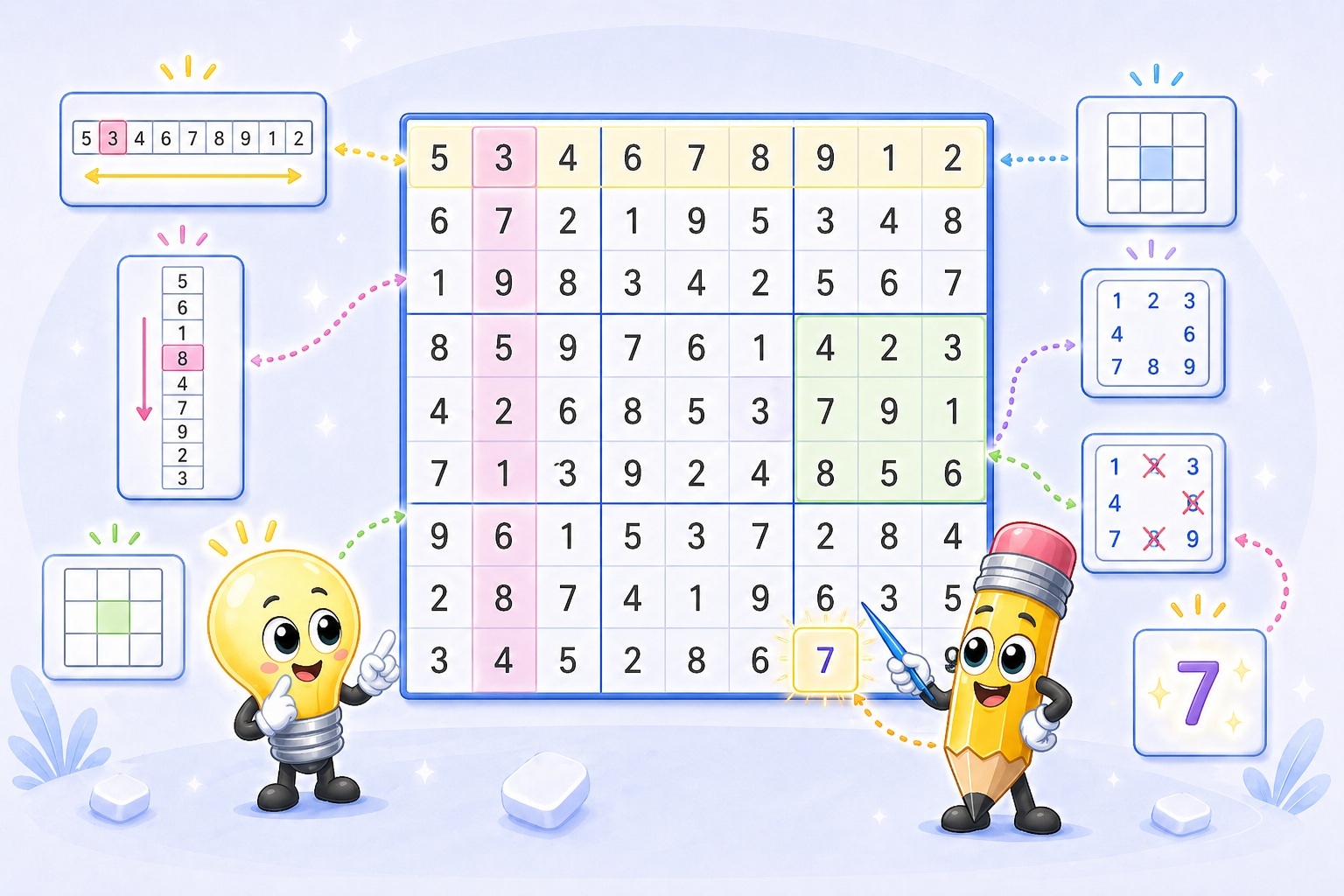
If you are new to Sudoku, the biggest jump is not learning a fancy pattern. It is learning where to look next. Good beginner solving is a calm routine: scan the grid, place the numbers that are forced, add notes only when they help, and keep returning to the easiest clues.
This guide gives you that routine. It focuses on the Sudoku strategies beginners actually need for easy and early medium puzzles: scanning, cross-hatching, missing-number checks, naked singles, hidden singles, pencil marks, and simple pairs. Use it as a checklist while you play.
The best Sudoku strategies for beginners are scanning rows, columns, and boxes; using cross-hatching to narrow a digit to one cell; finding naked singles and hidden singles; adding pencil marks when progress slows; and checking simple pairs before guessing.
The fastest way to learn beginner Sudoku strategy is to use each idea on a real puzzle immediately. Open an easy puzzle in another tab, make one logical placement, then come back to the next step.
Best for scanning, missing-number checks, and your first hidden singles.
Play Easy Sudoku
Use this after easy puzzles when pencil marks and simple pairs start to matter.
Play Medium SudokuClassic Sudoku has one rule: each row, column, and 3x3 box must contain the digits 1 to 9 once each. Beginners often stare at all 81 cells at once, which makes the puzzle feel larger than it is. Instead, treat every row, column, and box as a small checklist.
When a row already has 1, 2, 3, 5, 7, and 8, it is only missing 4, 6, and 9. That smaller list is easier to test against the crossing columns and boxes. Most beginner progress comes from shrinking big questions into little ones.
Use this order every time you get stuck. It prevents random searching and keeps you from adding too many notes too early.
This example uses an easy, nearly finished grid so the logic is visible. The point is not that every Sudoku will be this full; the point is the order of thought. You look for the smallest local question, answer it, then use that answer to unlock the next one.
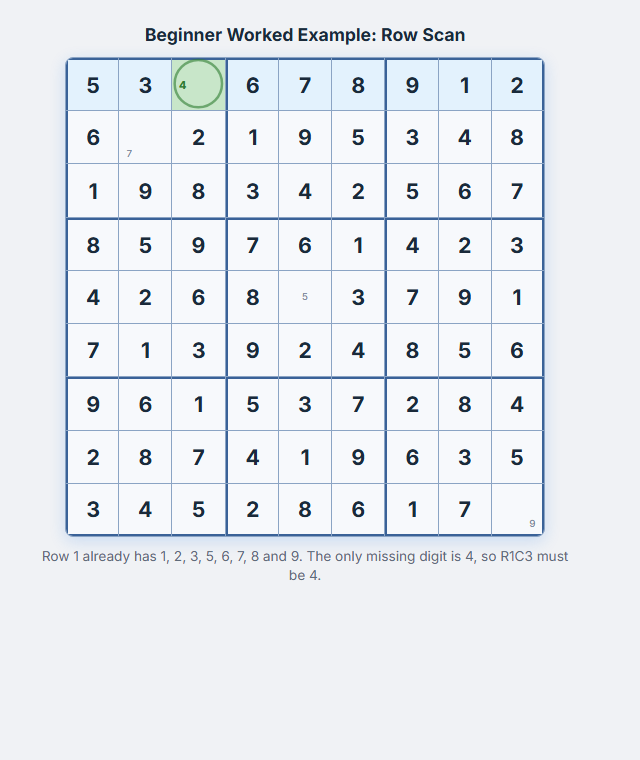
Row 1 already contains 1, 2, 3, 5, 6, 7, 8, and 9. The only missing digit is 4, so the empty cell in that row, R1C3, must be 4.
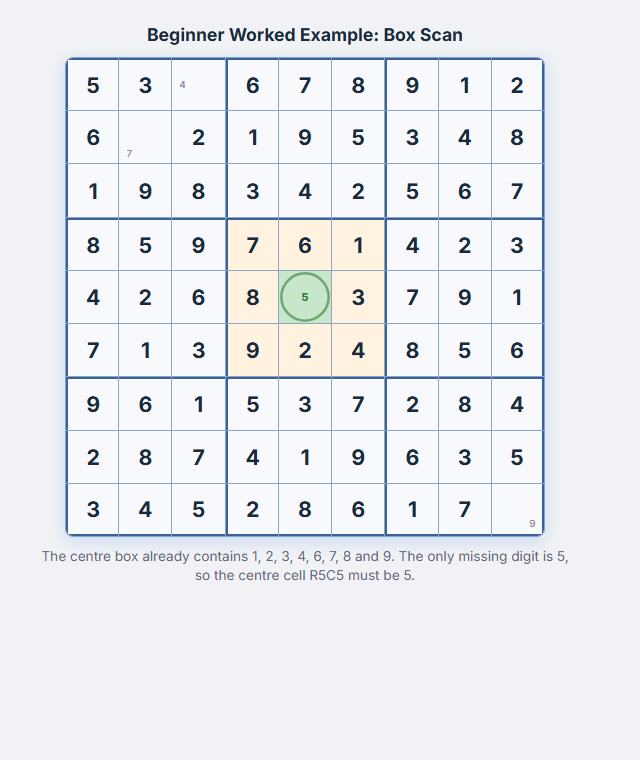
After placing easy numbers, check the related boxes again. In the centre 3x3 box, the digits 1, 2, 3, 4, 6, 7, 8, and 9 are already present. The only missing digit is 5, so R5C5 must be 5.
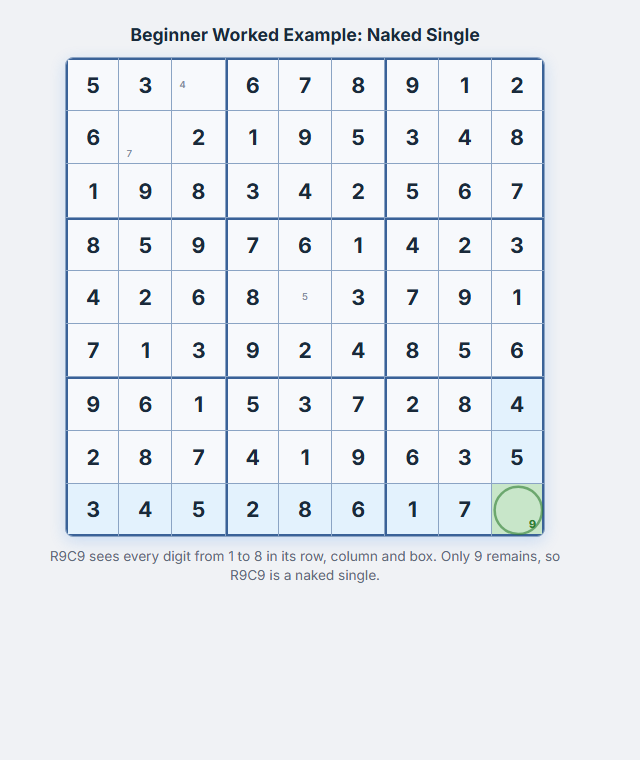
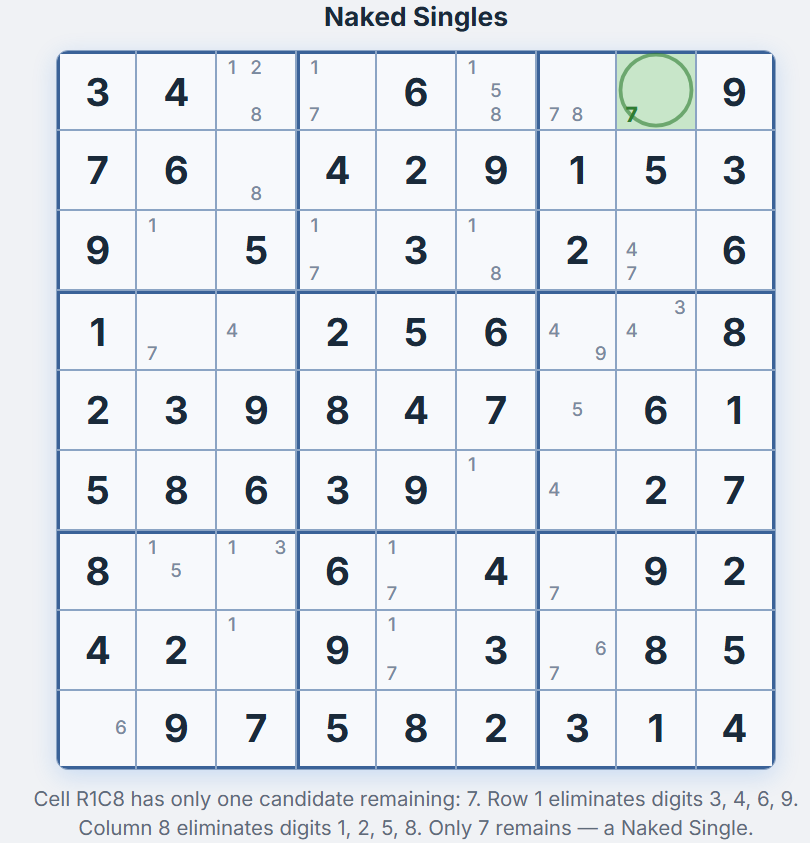
Now look at R9C9. Its row, column, and box already rule out every digit from 1 to 8. Only 9 remains. That is a naked single: one cell with one possible answer.
That is the beginner loop in miniature: find a nearly complete unit, place the forced digit, then rescan the affected row, column, and box. If no forced digit appears, add clean pencil marks and look for singles.
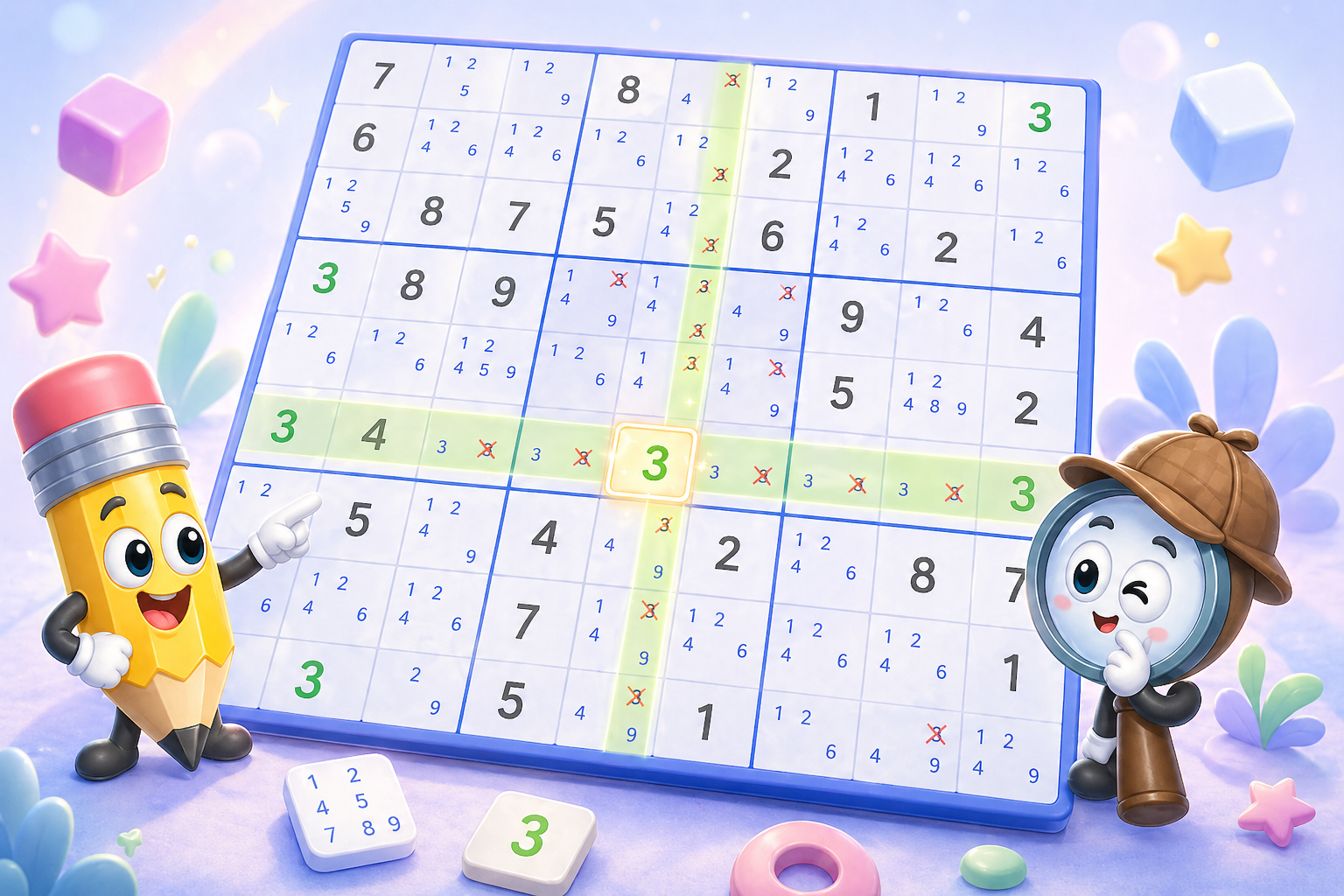
Scanning means looking across rows, columns, and boxes for digits that are almost forced. Cross-hatching is the most useful version of scanning. Choose one digit, such as 7, then look at a 3x3 box. If existing 7s in nearby rows and columns block every empty cell except one, that last cell must be 7.
A good beginner habit is to scan one number at a time from 1 through 9. Do not bounce around the grid hoping something appears. Ask a clean question: where can the 1s go? Then the 2s, then the 3s, and so on.
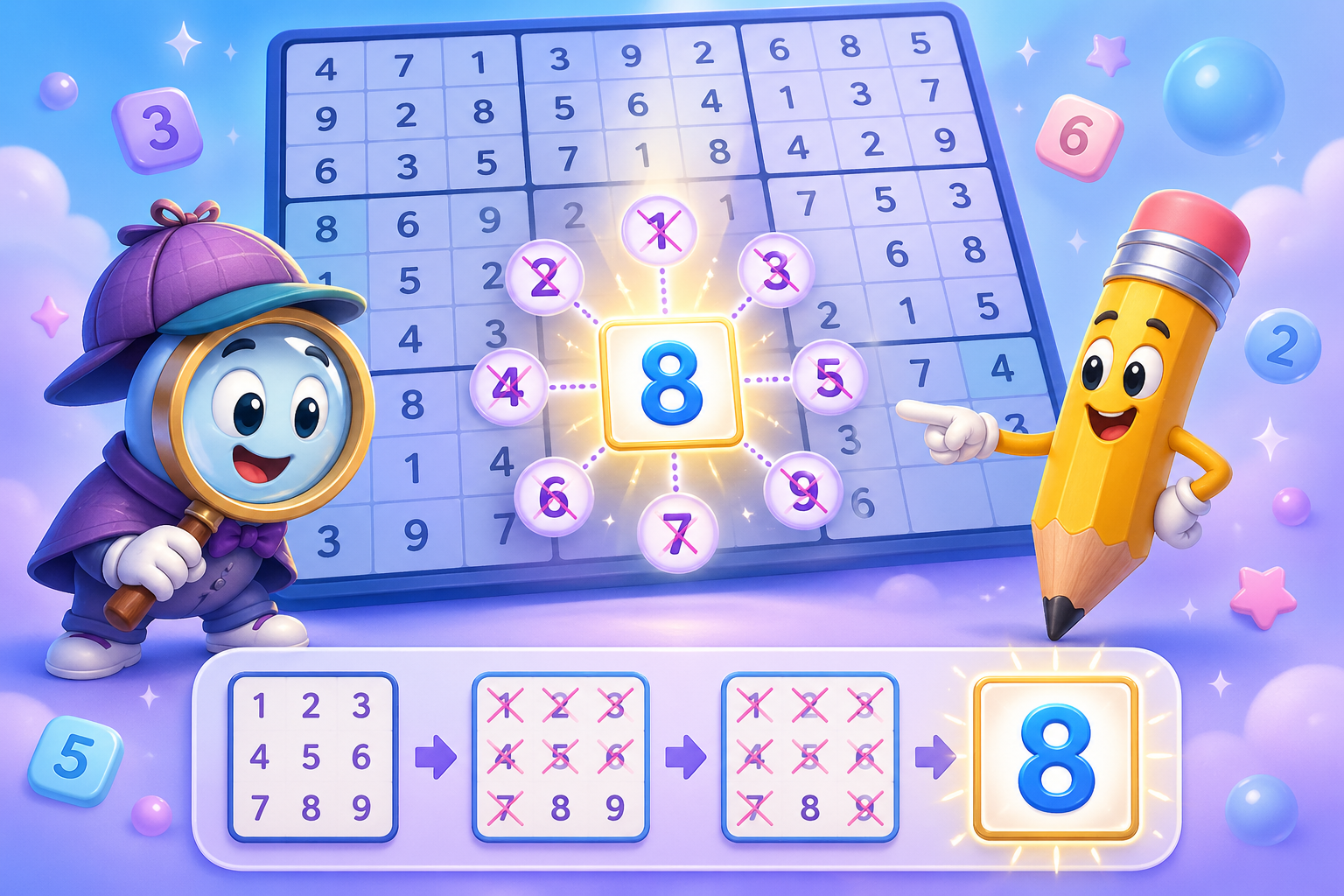
A naked single is a cell with only one possible digit left. If a cell sees 1, 2, 3, 4, 5, 6, 8, and 9 in its row, column, or box, the answer is 7. Naked singles become much easier to spot once you use pencil marks.
A hidden single is a digit that has only one possible place inside a row, column, or box. The cell may have several pencil marks, but the unit has only one place for that digit. Hidden singles are the heart of beginner Sudoku. If you learn one strategy well, make it this one.
Pencil marks are small candidate notes in empty cells. They are helpful, but they are not the first move on every puzzle. On easy grids, start by scanning. Add notes when you find yourself checking the same row or box twice without making progress.
For beginners, full notes are usually easier than partial notes. Fill each empty cell with the digits still allowed by its row, column, and box. Then clean the notes after every placement. Accurate notes reveal naked singles, hidden singles, and pairs; old notes create false patterns.
For a deeper explanation of notes, see our Sudoku pencil marks guide. When you are ready for a broader map, the complete Sudoku techniques list shows what comes after beginner logic.
A naked pair happens when two cells in the same row, column, or box contain the same two candidates, such as {2, 8} and {2, 8}. Those two digits must occupy those two cells, so 2 and 8 can be removed from the other cells in that unit.
A hidden pair is slightly different: two digits appear only in the same two cells within a unit, even if those cells have extra notes. The pair lets you remove the extra notes from those cells. Beginners do not need to hunt pairs constantly, but pairs are the first real step beyond singles.
| Mistake | Why it hurts | Better habit |
|---|---|---|
| Guessing too early | One wrong number can poison the whole grid. | Only place a number when you can explain why it is forced. |
| Writing every note before scanning | The puzzle becomes visually noisy. | Scan first, add notes when progress slows. |
| Ignoring boxes | Many beginner clues are box-based. | Check rows, columns, and boxes as equal partners. |
| Not updating notes | Old candidates create fake singles and fake pairs. | Clean the affected row, column, and box after each placement. |
Start with easy puzzles and solve slowly on purpose. Before placing each digit, say the reason: "this is the only place for 5 in the box" or "this cell can only be 3." That habit builds real skill faster than racing the timer.
When easy puzzles feel comfortable, move to medium puzzles and use pencil marks earlier. Your goal is not to memorize dozens of named techniques. Your goal is to make scanning, singles, and clean notes automatic.
The easiest Sudoku strategy is scanning: look across rows, columns, and boxes to find where a missing number has only one possible place.
Yes, but usually after scanning. Pencil marks are most helpful when obvious placements stop and you need to track candidates.
A naked single is a cell with one candidate left. A hidden single is a digit that has only one possible position in a row, column, or box.
Guessing is not needed for a proper Sudoku puzzle. Beginner strategies should still be logical: every placement should have a reason.
After scanning, singles, notes, and simple pairs, learn locked candidates, pointing pairs, naked pairs, hidden pairs, and then X-Wing.