 Sudoku
Killer Sudoku
Practice cage sums, combinations, pencil marks, and standard Sudoku logic in one puzzle.
Play Killer SudokuA complete roundup of the Killer Sudoku tips that matter most, from cage arithmetic and combinations to innies, outies, locked candidates, and advanced solving flow.
Written by Brian Hamilton and Karan Hamilton.
Brian and Karan are the puzzle lovers and game makers behind Sudoku Online Puzzles. You can learn more on the About page.
Guides are reviewed for clarity, accuracy, and usefulness for solvers. See our editorial standards, puzzle testing process, or send a correction.
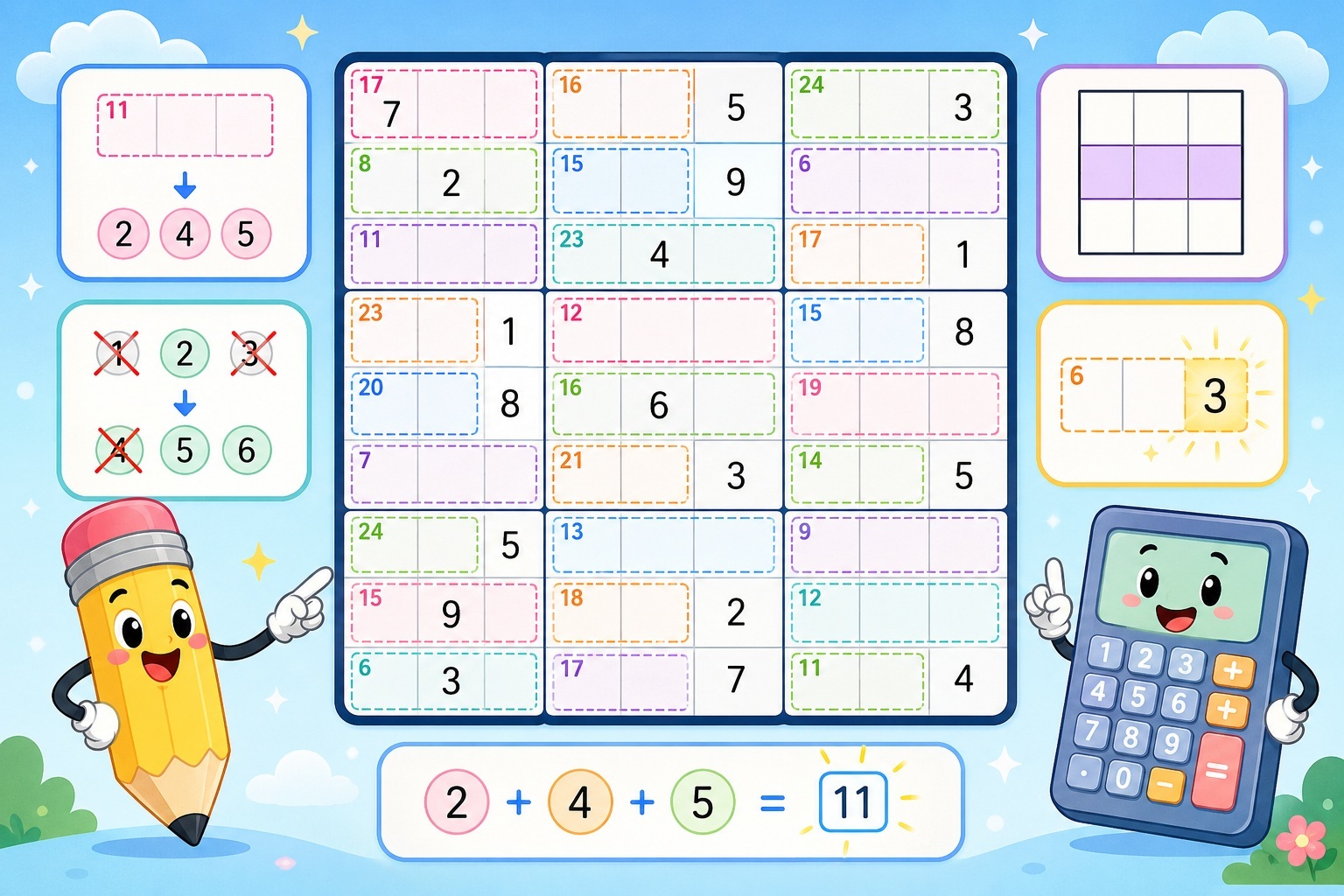
Start with the Rules of Killer Sudoku guide if you want the full cage, sum, and no-repeat explanation before using this strategy.
Killer Sudoku looks intimidating because every cage adds arithmetic on top of the usual row, column, and box rules. The secret is that you do not need to calculate everything at once. A good solve is a steady rhythm: use standard Sudoku logic, narrow cages with combinations, then let each new digit simplify the next cage.
This guide is a roundup of Killer Sudoku tips and strategies, arranged from beginner-friendly habits to advanced patterns. You can read it straight through, or treat it as a checklist when a Killer puzzle stops moving.
The best Killer Sudoku tips and strategies are to use normal Sudoku rules first, list only valid cage combinations, memorize small cage sums, apply the rule of 45 to houses, look for innies and outies, keep cage notes separate from cell notes, and update candidates after every placement. Most Killer Sudoku progress comes from combining arithmetic pressure with ordinary singles, pairs, locked candidates, and fish.
Open a Killer Sudoku puzzle and test one idea at a time. The strategies below work best when you apply them slowly: one cage, one house, one candidate cleanup, then another pass through the grid.
Practice cage sums, combinations, pencil marks, and standard Sudoku logic in one puzzle.
Play Killer Sudoku
Use one fresh puzzle each day to build a repeatable solving routine.
Play Daily Killer
Check a difficult cage calculation or study one logical step when you are stuck.
Open Killer SolverKiller Sudoku uses the normal Sudoku rule: each row, column, and 3x3 box contains the digits 1 to 9 once each. It adds dashed cages. The numbers inside a cage must add up to the clue in the corner of that cage.
On most Killer Sudoku puzzles, digits cannot repeat inside a cage. That no-repeat cage rule is the reason combination lists are so powerful. A two-cell cage that sums to 3 must be 1+2. A three-cell cage that sums to 24 must be 7+8+9. Before thinking about advanced logic, squeeze every obvious cage.
The first Killer Sudoku strategy is almost too easy to overlook: solve it like Sudoku whenever possible. A row, column, or box can still have naked singles, hidden singles, locked candidates, pairs, triples, and X-Wings. The cages give extra clues, but they do not replace classic solving.
Scan for completed or nearly completed houses. If a row already has six digits, the remaining three digits tell you which cage combinations are still possible. If a box contains a cage with only one empty cell, the cage sum may give a direct placement. Bounce between the two information sources instead of treating Killer as pure arithmetic.
Cage combinations are the heart of Killer Sudoku. A cage clue tells you the total; the number of cells tells you how many different digits must make that total. The fewer combinations a cage has, the more useful it is.
Memorize the extreme sums first because they are forced or nearly forced. For two cells, 3 is 1+2, 4 is 1+3, 16 is 7+9, and 17 is 8+9. For three cells, 6 is 1+2+3, 7 is 1+2+4, 23 is 6+8+9, and 24 is 7+8+9. For four cells, 10 is 1+2+3+4 and 30 is 6+7+8+9.
Do not write every possible combination into every cage. Start with the combinations that interact with solved digits nearby. If a 17 cage in two cells crosses a row that already contains 8, the cage is no longer 8+9; it must put 9 in the other cell or become impossible, depending on the exact position.
Every row, column, and 3x3 box in a 9x9 Sudoku adds up to 45, because 1+2+3+4+5+6+7+8+9 = 45. Killer Sudoku turns that fact into one of its most useful strategies.
If cages sit entirely inside a row, column, or box and their sums add to 45, those cages account for the whole house. If they add to less than 45, the missing amount belongs to the cells not covered by those cages. If they add to more than 45 because a cage spills outside the house, the extra amount belongs to the outside cells.
Use this early on every box. Boxes are often easier than rows and columns because cage shapes tend to stay local. Add the cage totals inside a box, compare with 45, and mark any forced leftovers.
An innie is a cell inside a row, column, or box that is not covered by the cages you are adding. An outie is a cell outside that house but included in a cage that mostly sits inside it. Both are just applications of the rule of 45.
Example: suppose the cages mostly inside a box total 50, and exactly one cage cell sticks out of the box. The box itself must total 45, so the outie is 5. If the cages inside a row total 41 and one uncovered cell remains in that row, the innie is 4.
The best innie and outie opportunities have one or two unknown cells. With more cells, you may not place a digit immediately, but you can often restrict a set of candidates and create a pair.
Good notes matter more in Killer Sudoku than in classic Sudoku because you are tracking both cell candidates and cage combinations. Keep them visually separate in your head: cell notes say what can go in a cell; cage notes say which groups of digits can fill the cage.
Write fewer, better notes. For a cage with many combinations, note only the digits that are forced across all combinations or excluded by the row, column, and box. When a cage has two or three possible combinations left, then it is worth writing the full set.
After every placement, update four things: the row, the column, the box, and every cage touched by the new digit. Many Killer Sudoku mistakes come from cleaning ordinary candidates but forgetting that a cage sum has changed.
Once basic cages slow down, return to standard Sudoku techniques. A cage can create a naked pair because two cells must be 2 and 7 in some order. A house can create a hidden single because only one cage cell can take a digit. A box-line interaction can remove candidates just as it would in a classic puzzle.
Look for cage-restricted pairs and triples. If a three-cell cage can only be {1, 4, 8} or {2, 3, 8}, then 8 may be locked in that cage. If all possible positions for 8 in the cage fall in one row, remove 8 from the rest of that row.
On hard Killer Sudoku puzzles, the strongest moves often combine small arithmetic with a normal technique: a 45 calculation creates a two-cell sum, the two-cell sum creates a pair, and the pair exposes a hidden single elsewhere. Follow the chain one modest step at a time.
Use this order when you feel stuck: scan solved digits, check one-cell cage remainders, inspect extreme cage sums, apply the rule of 45 to each box, clean candidates, look for singles and pairs, then repeat for rows and columns.
If none of that works, choose the most constrained area of the grid. A cage crossing two nearly full houses is usually better than a wide open cage in an empty corner. Killer Sudoku rewards local pressure, so work where several constraints overlap.
Do not jump to trial and error. A well-made Killer Sudoku puzzle is designed to be solved logically. If a move feels like a guess, back up and ask which cage, row, column, or box can be made smaller.
The most common mistake is over-noting: filling the grid with every combination before the puzzle has given enough context. That makes the puzzle look harder than it is. Start with forced sums, nearly forced sums, and cages affected by placed digits.
Another common error is forgetting the no-repeat cage rule. Unless a puzzle explicitly says otherwise, a cage cannot use the same digit twice. A two-cell 10 cage is not 5+5; it can be 1+9, 2+8, 3+7, or 4+6.
Finally, watch for arithmetic drift. When you subtract solved digits from a cage, say the remaining sum and the remaining cell count together. "This is now 11 in two cells" is safer than just writing 11 in the margin.
These are not the only useful combinations, but they are the ones that pay off constantly in beginner and intermediate Killer Sudoku puzzles.
| Cage | Forced or narrow combinations | Why it matters |
|---|---|---|
| 2 cells = 3 | 1+2 | Both digits are forced. |
| 2 cells = 4 | 1+3 | Both digits are forced. |
| 2 cells = 16 | 7+9 | Both digits are forced. |
| 2 cells = 17 | 8+9 | Both digits are forced. |
| 3 cells = 6 | 1+2+3 | The lowest three digits are forced. |
| 3 cells = 7 | 1+2+4 | A narrow low cage that quickly creates exclusions. |
| 3 cells = 23 | 6+8+9 | A narrow high cage. |
| 3 cells = 24 | 7+8+9 | The highest three digits are forced. |
| 4 cells = 10 | 1+2+3+4 | The lowest four digits are forced. |
| 4 cells = 30 | 6+7+8+9 | The highest four digits are forced. |
Killer Sudoku is not just arithmetic. The best strategy is to let arithmetic and Sudoku logic feed each other: cages reduce candidates, candidates reduce cages, and every placement makes the next pass cleaner.
Start with normal Sudoku scanning, then use small cage sums and the rule of 45. Do not fill the grid with every combination too early.
Each row, column, and 3x3 box adds to 45. If cage totals inside a house do not equal 45, the difference identifies innies, outies, or missing cells.
Usually no. Most Killer Sudoku puzzles use the rule that digits cannot repeat inside a cage, unless the puzzle states a different rule.
No. Memorize the extreme low and high sums first, then learn the common two-cell and three-cell totals through practice.
It can be, because it combines arithmetic with standard Sudoku logic. Easy Killer puzzles may be simpler than hard classic Sudoku, while expert Killer puzzles can be very demanding.
Yes. Use pencil marks, but keep them tidy. Separate cell candidates from cage combinations and update both after each placement.