 Sudoku
Written by Brian Hamilton and Karan Hamilton.
Brian and Karan are the puzzle lovers and game makers behind Sudoku Online Puzzles. You can learn more on the About page.
Guides are reviewed for clarity, accuracy, and usefulness for solvers. See our editorial standards, puzzle testing process, or send a correction.
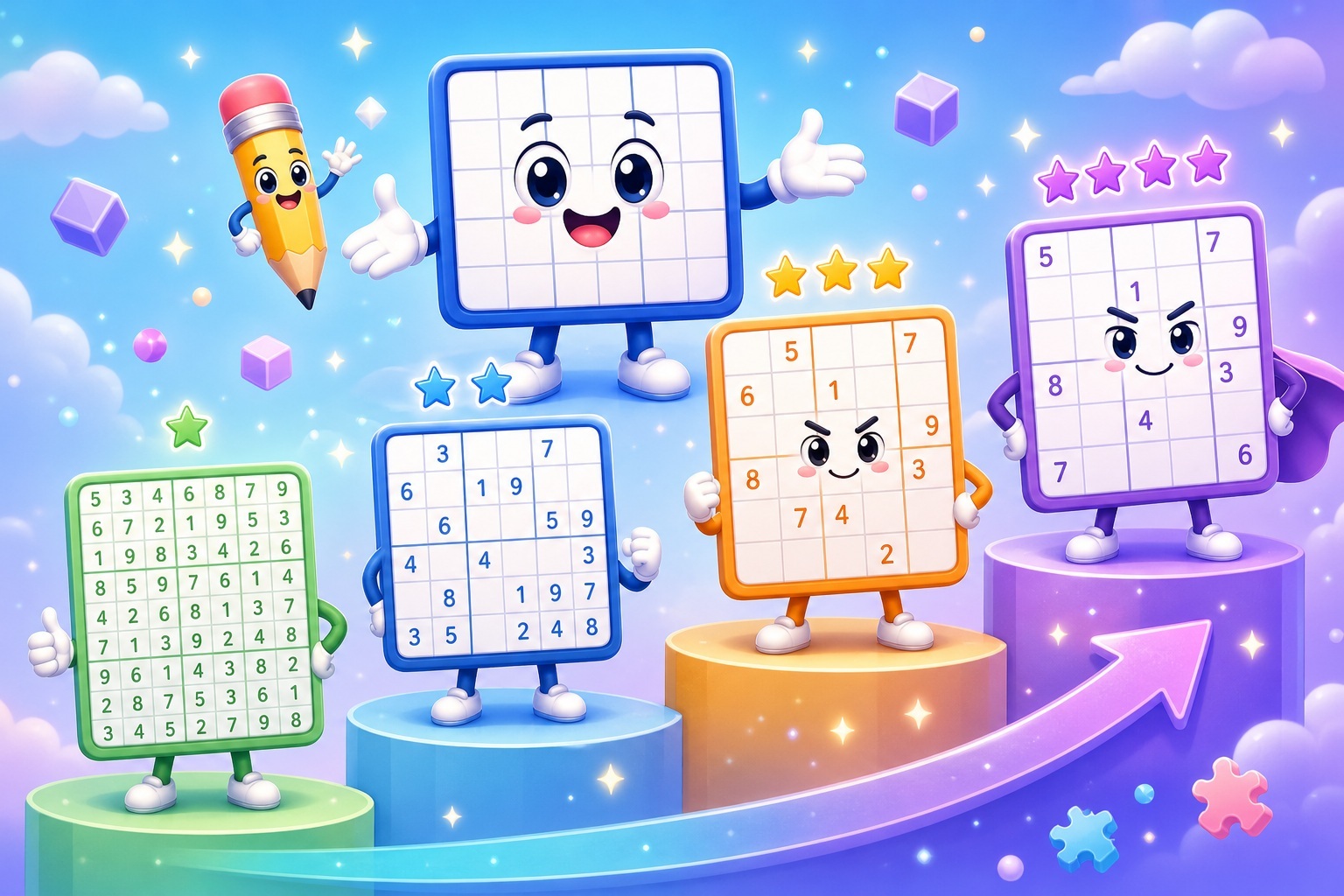
What do Sudoku difficulty levels mean?
Sudoku difficulty levels describe the amount and type of logic needed to solve a puzzle. A good rating answers a human question: how hard will this feel if I solve it without guessing?
The most useful Sudoku difficulty levels are easy, medium, hard, expert and sometimes evil or extreme. The names vary between sites, but the pattern is similar. As the level rises, obvious placements disappear sooner, notes become more important, and each move may depend on several smaller observations.
Quick answer
Sudoku difficulty levels are usually based on the solving logic required, not just the number of given clues. Easy puzzles can be solved with scanning and singles. Medium puzzles add pencil marks and simple pairs. Hard puzzles need candidate eliminations such as locked candidates and X-Wing. Expert puzzles require longer chains, fish patterns, uniqueness logic or very careful multi-step reasoning.
Sudoku difficulty chart: easy to expert
Use this chart as a practical map rather than a strict law. Two puzzles with the same label can feel different because layout, symmetry, and the order of deductions matter.
| Level | Typical solving experience | Common techniques | Best for |
|---|---|---|---|
| Easy | Many direct placements; notes are optional. | Scanning, cross-hatching, naked singles, hidden singles. | Beginners and quick relaxed play. |
| Medium | Obvious moves slow down; notes become useful. | Full pencil marks, singles, simple naked pairs and hidden pairs. | Players learning a repeatable solving routine. |
| Hard | Candidate eliminations are required before new singles appear. | Locked candidates, pointing pairs, box-line reduction, pairs, X-Wing. | Solvers comfortable with notes who want real strategy practice. |
| Expert | Progress depends on multi-step patterns and careful candidate logic. | Fish, wings, colouring, chains, uniqueness patterns, ALS-style eliminations. | Advanced solvers who enjoy analysis. |
| Evil or Extreme | Long gaps between placements; one missed candidate can hide the route. | Advanced chains, difficult fish, forcing logic, very sparse deductions. | Specialist solvers and slow deep practice. |
Why clue count does not define difficulty
Many players assume fewer givens always mean a harder puzzle. Clue count matters, but it is a weak signal. A 27-clue puzzle can be easier than a 32-clue puzzle if the 27 clues create many singles and the 32 clues hide a difficult chain.
Difficulty comes from the path to the solution. If every step is a forced single, the puzzle is easy even with relatively few clues. If the grid stalls until you find a locked candidate, X-Wing, finned fish or chain, the puzzle belongs at a higher level even if it starts with more givens.
Techniques you should expect at each level
The cleanest way to understand Sudoku difficulty levels is to ask which techniques the puzzle expects. You do not need to learn every named pattern at once. Learn the next technique only when your current level stops giving you progress.
| If easy feels right | Practice scanning one digit at a time and explaining every placement before you enter it. |
|---|---|
| If medium feels right | Keep full notes, update them after every placement, and look for singles before pairs. |
| If hard feels right | Study locked candidates, pointing pairs, naked pairs, hidden pairs and X-Wing until they feel visual. |
| If expert feels right | Work through fish, wings, chains and colouring with examples; accuracy matters more than speed. |
How online Sudoku difficulty ratings work
Most online Sudoku generators rate puzzles with a solver. The solver tries human-style techniques in order: singles first, then pairs, locked candidates, fish, wings, chains and so on. The puzzle receives a score based on the hardest required technique, how often difficult techniques appear, and how much branching or search would be needed.
That is why ratings differ between websites. One solver may call a puzzle hard because it needs X-Wing. Another may call it expert if its solver reaches the same placement through a longer chain. Ratings are helpful, but your personal difficulty also depends on which techniques you already recognize quickly.
Which Sudoku level should you play?
Play the level where you can make logical progress most of the time but still pause often enough to learn. If you finish every puzzle without using notes, move up. If you stare for ten minutes before the first placement, move down and strengthen the previous skill.
For relaxed daily play, choose a level you solve with a little resistance. For training, choose puzzles just above your comfort zone and review every stuck point. A good training puzzle teaches one new kind of move; a bad training puzzle makes you guess.
How to move from one level to the next
Move from easy to medium by learning clean pencil marks and hidden singles. Move from medium to hard by practicing naked pairs, hidden pairs, pointing pairs and box-line reduction. Move from hard to expert by learning X-Wing, Swordfish, XY-Wing, simple colouring and candidate chains.
Do not rush the labels. A player who can solve medium puzzles neatly is building stronger skill than a player who guesses through hard puzzles. The habit that transfers across every level is simple: after each placement, rescan the affected row, column and box before hunting for something complicated.
Common myths about Sudoku difficulty
Myth one: expert Sudoku means arithmetic. Classic Sudoku uses digits as symbols, not quantities. The difficulty is logical, not mathematical calculation.
Myth two: every hard puzzle needs guessing. A well-made Sudoku with a unique solution can be solved by logic. Some logic may be advanced, but a guess is a shortcut, not a requirement.
Myth three: a timer measures difficulty. Speed measures familiarity, eyesight, note habits and interface comfort. A puzzle is difficult because of its logical path, not because someone solved it slowly.
For step-by-step basics, read our Sudoku strategies for beginners. For a broader map of named patterns, use the complete Sudoku techniques list. If your notes feel messy, start with the Sudoku pencil marks guide.
Frequently Asked Questions
The most common Sudoku difficulty levels are easy, medium, hard, expert and sometimes evil or extreme. The names vary, but they usually reflect the hardest logic required.
Not reliably. Clue count can influence difficulty, but the solving path matters more. A puzzle with fewer clues can be easier if the clues create many forced placements.
A Sudoku puzzle becomes hard when singles are not enough and you must remove candidates using techniques such as locked candidates, pairs, X-Wing or chains.
Beginners should start with easy Sudoku until scanning, hidden singles and simple pencil marks feel natural. Then medium puzzles are the best next step.
A proper classic Sudoku puzzle with a unique solution should be solvable by logic. Guessing may solve a grid, but it is not the intended solving method.
Move up when you can finish most puzzles at your current level with clear logical reasons and only occasional stalls. If you are guessing often, stay at the current level a little longer.