 Sudoku
Play Killer Sudoku
Use the rules immediately on an interactive Killer Sudoku grid with cage sums and difficulty levels.
Play nowA complete beginner guide to Killer Sudoku rules, cage sums, no-repeat cages, examples, and the first solving ideas you need before playing.
Written by Brian Hamilton and Karan Hamilton.
Brian and Karan are the puzzle lovers and game makers behind Sudoku Online Puzzles. You can learn more on the About page.
Guides are reviewed for clarity, accuracy, and usefulness for solvers. See our editorial standards, puzzle testing process, or send a correction.
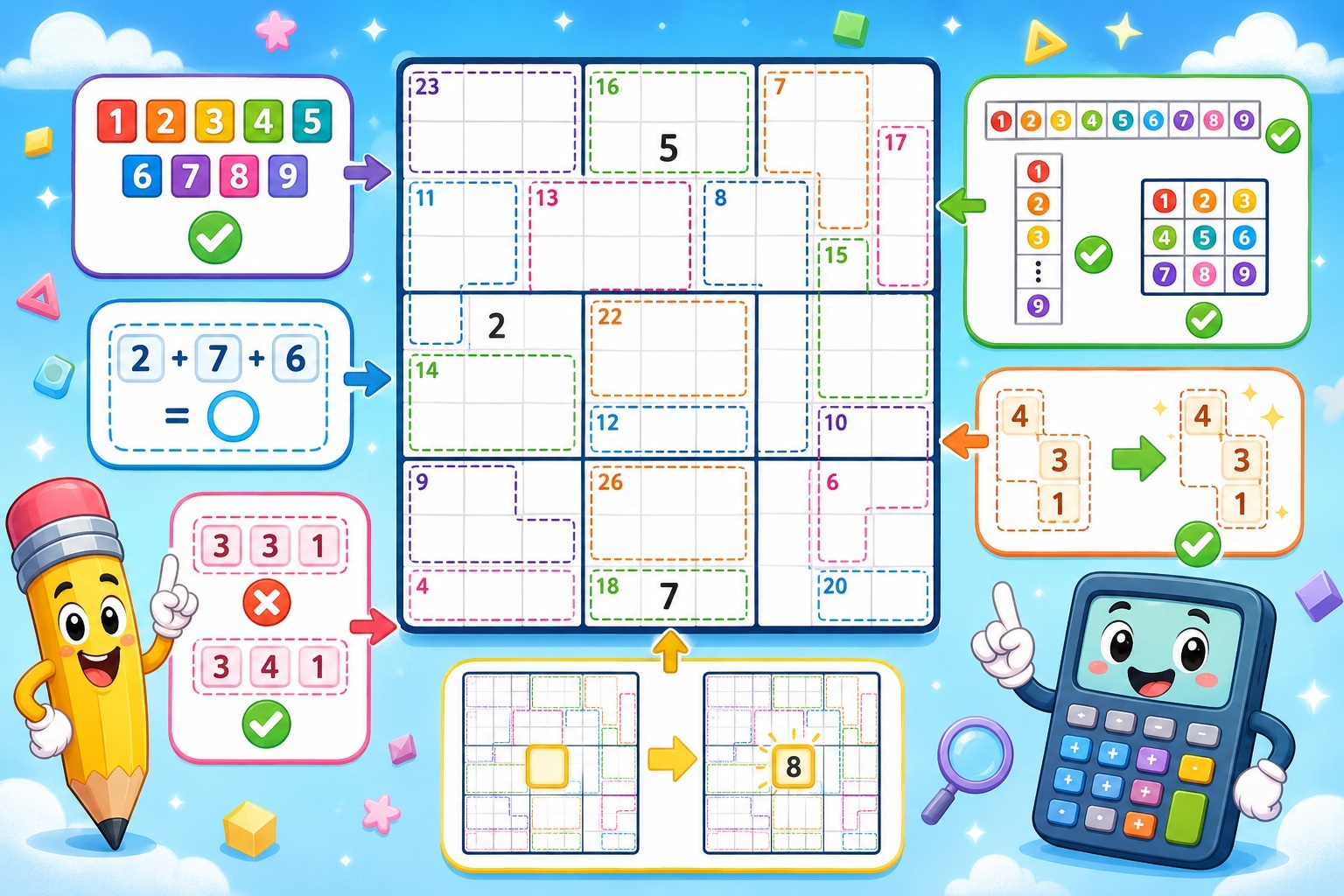
The rules of Killer Sudoku are simple, but the puzzle feels different from classic Sudoku because the grid usually starts with no given digits. Instead of clues printed in cells, you get outlined groups of cells called cages. Each cage has a small number showing the sum of the digits inside it.
This guide explains the rules clearly, then goes a step further: how to read cage clues, why repeats are normally forbidden, how to make your first deductions, and when to move from pure rules into beginner strategy.
Killer Sudoku uses the normal Sudoku rules plus cage sums. Fill every row, column, and 3x3 box with 1-9. Each outlined cage must add to its small clue number, and digits cannot repeat inside a cage unless the puzzle explicitly says repeats are allowed.
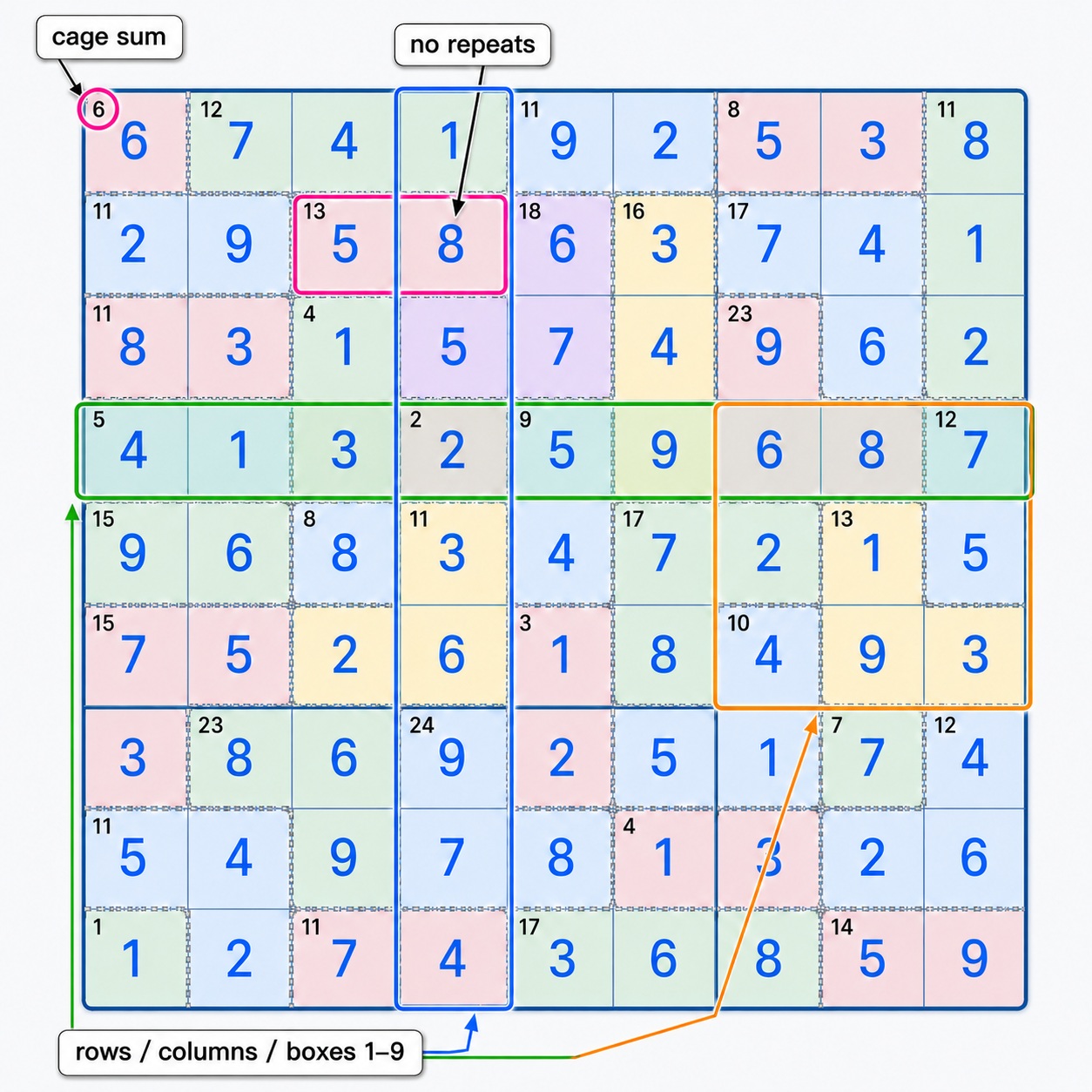
Killer Sudoku is a 9x9 Sudoku variant that combines classic Sudoku logic with arithmetic cage clues. You still fill the grid with digits 1 to 9, and every row, column, and 3x3 box still contains each digit exactly once.
The difference is the clue system. A classic Sudoku gives you starting digits. Killer Sudoku usually gives you an empty grid divided into cages. The cage totals tell you which groups of digits can fit, and the Sudoku rules tell you where those digits can go.
Killer Sudoku is sometimes called Sum Sudoku or Samunamupure. The important idea is that you are not guessing arithmetic answers; you are combining sums with normal Sudoku logic.
A standard Killer Sudoku puzzle follows five rules. The first three are classic Sudoku rules, and the last two are Killer-specific rules.
Together, these rules mean each cage is both an arithmetic clue and a Sudoku region. A cage sum can narrow the possible digits, while rows, columns, and boxes decide the order.
| Rule | What it means | Why it matters |
|---|---|---|
| Rows | Each row contains 1-9 exactly once. | A cage cannot force a row to repeat a digit. |
| Columns | Each column contains 1-9 exactly once. | Column restrictions often decide the order inside a cage. |
| Boxes | Each 3x3 box contains 1-9 exactly once. | Box boundaries are important for cage combinations and the rule of 45. |
| Cages | The digits in each cage add to the clue total. | The cage sum replaces the given numbers used in classic Sudoku. |
| No repeats in cages | A digit cannot appear twice in the same cage unless a puzzle says otherwise. | This makes sums like 10 in two cells exclude 5+5. |
A cage is an outlined or coloured group of cells. The small number in the cage, usually shown in the top-left cell, is the total for the whole cage. If a cage says 12 and contains three cells, those three cells must add to 12.
Cage clues do not usually tell you the order of the digits. A two-cell cage totaling 7 might be 1+6, 2+5, or 3+4 before other restrictions. If one of those cells shares a row with a solved 6, then the 1+6 option may become impossible in that position.
Single-cell cages are direct givens: a one-cell cage with clue 5 is simply a 5. Many online Killer puzzles avoid too many single-cell cages, but they are legal.
| Cage clue | Possible digits | Beginner meaning |
|---|---|---|
| 2 cells = 3 | 1+2 only | Both digits are known, but their order is not. |
| 2 cells = 4 | 1+3 only | A forced pair that removes 1 and 3 from shared peers. |
| 2 cells = 10 | 1+9, 2+8, 3+7, 4+6 | The sum is not enough by itself; use row, column, and box restrictions. |
| 2 cells = 17 | 8+9 only | A high forced pair. |
| 3 cells = 6 | 1+2+3 only | The three lowest digits are locked into the cage. |
| 3 cells = 24 | 7+8+9 only | The three highest digits are locked into the cage. |
In standard Killer Sudoku, a digit cannot repeat inside a cage. This matters even when repeated digits would make the arithmetic work. A two-cell cage totaling 10 cannot be 5+5 because the cage would repeat 5.
This no-repeat rule is separate from ordinary Sudoku restrictions. If two cage cells are in different rows, different columns, and different boxes, they still cannot repeat if they belong to the same cage.
Some variant puzzles allow cage repeats or say that repeats are allowed when cells do not see each other. Treat that as a special rule. If no special rule is stated, assume cage digits do not repeat.
Start with the smallest and most extreme cages. Low totals and high totals have fewer possible combinations, so they give you the first useful restrictions. A 3-cell cage totaling 6 must be 1+2+3; a 3-cell cage totaling 24 must be 7+8+9.
Next, ask where those digits can sit. If a forced cage lies entirely inside one box, all of its digits are locked into that box. If the same cage also touches one row or column in a useful way, ordinary Sudoku eliminations often follow.
Keep notes light at the beginning. Write exact combinations for forced or nearly forced cages, but do not fill every cell with every possible digit. The best early progress usually comes from combining one cage sum with one row, column, or box restriction.
Every complete row, column, and 3x3 box in a 9x9 Sudoku totals 45, because 1+2+3+4+5+6+7+8+9 = 45. Killer Sudoku makes that fact useful because cage sums can be added and subtracted.
If the cages fully inside a box add to 41 and one cell in the box is not covered by those cages, that uncovered cell must be 4. If cages mostly inside a box add to 52 but one cage cell sticks outside the box, the outside cell must be 7.
The Rule of 45 is usually the first strategy to learn after the rules. It explains innies and outies, and it turns messy cage layouts into clean sums.
You do not need to memorize every Killer Sudoku combination before playing. Start with forced extremes, because they are easy to remember and appear often in beginner puzzles.
A combination tells you the group of digits in a cage, not their positions. A 17 cage in two cells is 8+9, but row, column, and box rules still decide which cell is 8 and which is 9.
| Situation | Useful shortcut | Next step |
|---|---|---|
| Very low or very high cage totals | Check whether only one combination is possible. | Use Sudoku placement rules to order the digits. |
| Cage sits inside one row, column, or box | The cage digits are locked in that house. | Remove those digits from the rest of the house. |
| One box is almost fully covered by cages | Use 45 minus the known cage totals. | The leftover cell or cells become a new sum clue. |
| Large cages | Use complements: the full set 1-9 totals 45. | Work out which digits are missing rather than listing every included digit. |
Imagine a 3-cell cage with total 6 in the upper-left box. The only possible digits are 1, 2, and 3. That means no other cell in that same 3x3 box can be 1, 2, or 3 if the cage is fully inside the box.
Now suppose one cell of that cage lies in a row that already contains a 1. That cell cannot be 1, so it must be 2 or 3. If another cage or column clue removes 2, the cell is 3. You started with a cage sum, then used normal Sudoku logic to place a digit.
That is the heart of Killer Sudoku: cage arithmetic creates a small set of candidates, and Sudoku logic turns that set into placements.
The first mistake is allowing repeated digits inside a cage. Unless the puzzle says otherwise, 5+5 is not allowed in a two-cell cage totaling 10.
The second mistake is treating a cage combination as an ordered answer. If a cage is 1+2+3, you know the digits in the cage, but not which digit goes in which cell.
The third mistake is forgetting normal Sudoku rules. Cage sums never replace rows, columns, and boxes; they work alongside them.
The fourth mistake is over-noting. If you write every possible combination everywhere, the useful information gets buried. Note the cage totals that are forced, nearly forced, or tied to a specific row, column, or box.
Most online and newspaper Killer Sudoku puzzles use the standard no-repeat cage rule. However, variant setters sometimes change that rule. A puzzle may say cage repeats are allowed, cages may not always have unique sums, or extra variant constraints may be added.
Always read the puzzle instructions before solving a variant. On this site, the playable Killer Sudoku follows the standard rule set: rows, columns, boxes, cage sums, and no repeats inside a cage.
Once the rules feel natural, the fastest progress comes from practicing on real grids and learning the three core follow-up topics: combinations, the Rule of 45, and general Killer Sudoku strategy.
Use the rules immediately on an interactive Killer Sudoku grid with cage sums and difficulty levels.
Play now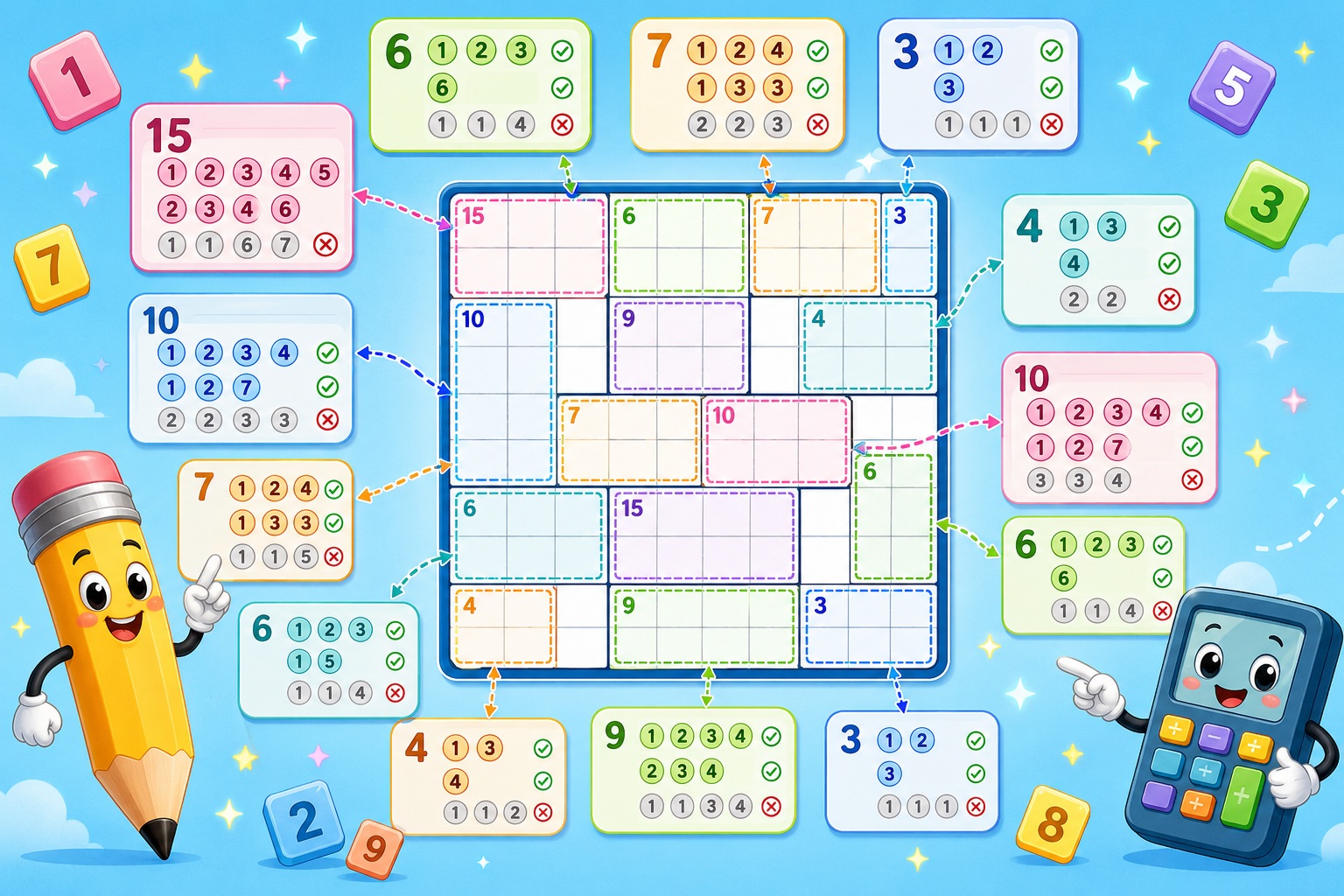
Learn the cage combination charts that make low, high, and awkward sums easier to solve.
Open combinations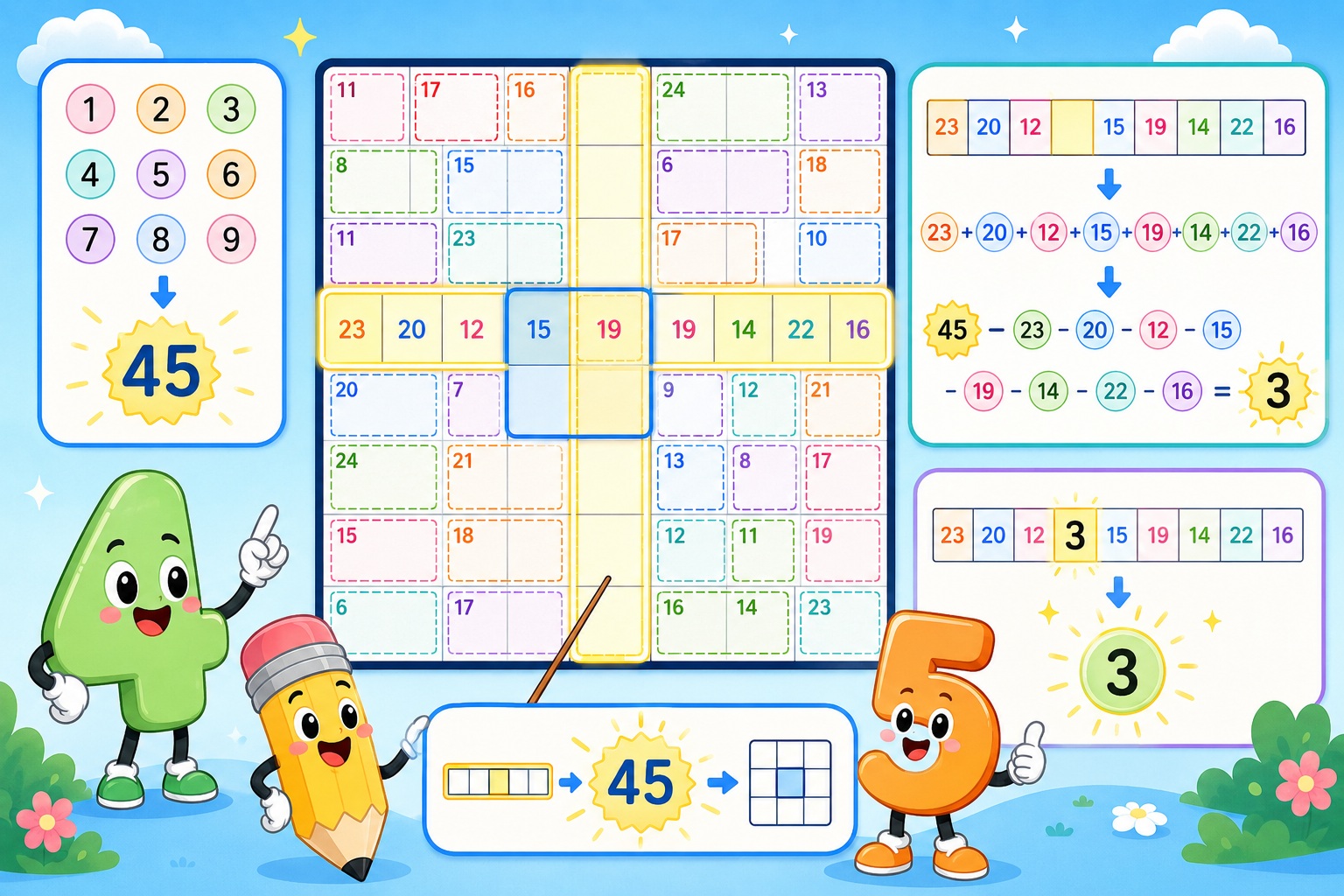
Turn rows, columns, and boxes into arithmetic shortcuts using 45, innies, and outies.
Learn Rule of 45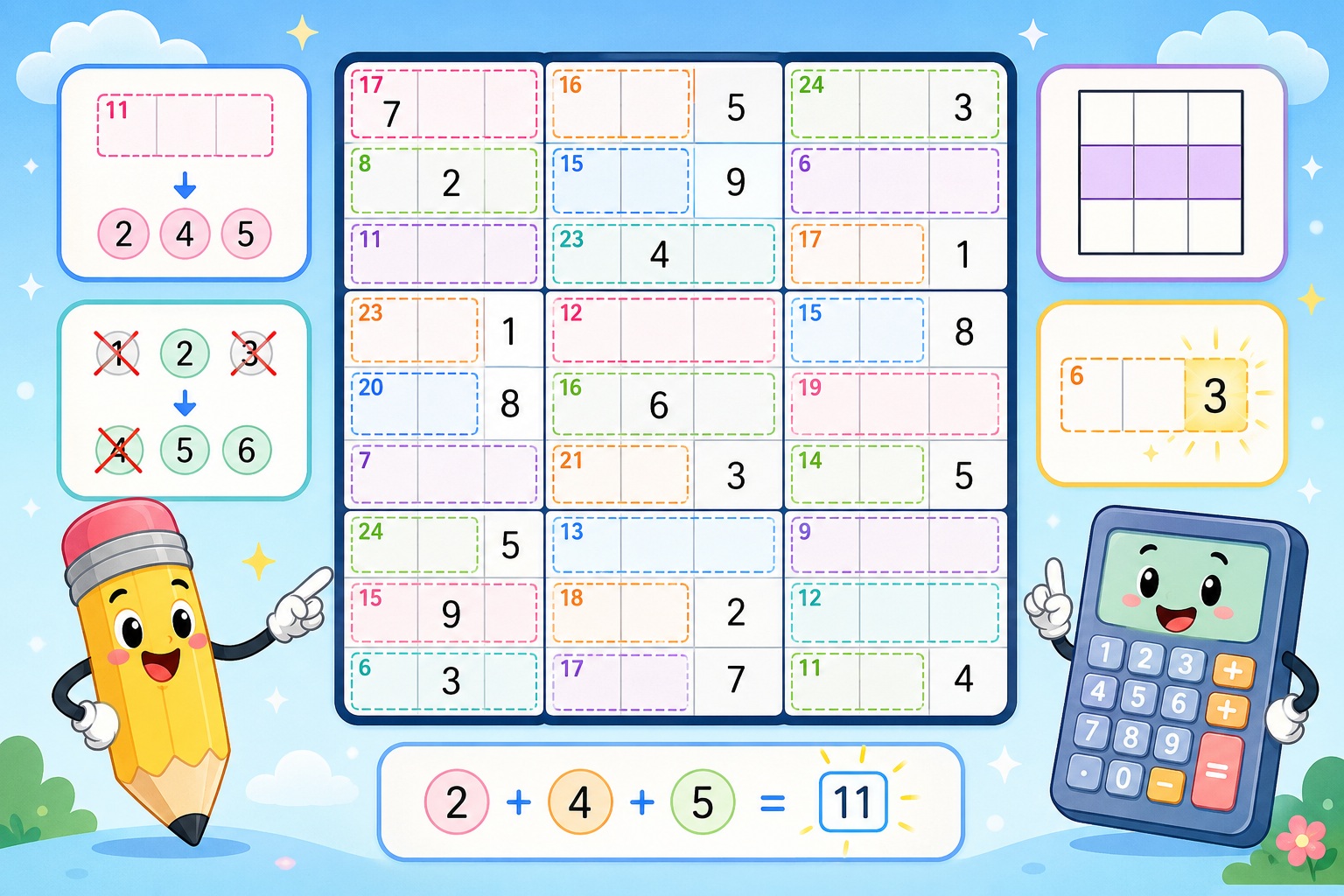
Move from rules into a full solving workflow with notes, pairs, cage interactions, and strategy habits.
Read tipsYes, Killer Sudoku is arithmetic, but the rules are still Sudoku rules first. Use cage sums to restrict the digits, then use rows, columns, and boxes to place them.
Fill every row, column, and 3x3 box with 1-9. Each cage must add to its clue total, and digits cannot repeat inside a cage unless the puzzle says otherwise.
In standard Killer Sudoku, no. A digit cannot repeat within the same cage, even if the repeated digits would add to the correct sum.
Usually no. Most Killer Sudoku puzzles start with an empty grid and use cage sums as the clues. Some easy puzzles may include single-cell cages, which act like givens.
Look for forced low and high cage sums, such as 2-cell 3, 2-cell 17, 3-cell 6, and 3-cell 24. Then combine those cages with row, column, and box restrictions.
It can be harder because it adds arithmetic cage constraints. Easy Killer Sudoku can still be beginner-friendly because many cages have forced combinations.