 Sudoku
Written by Brian Hamilton and Karan Hamilton.
Brian and Karan are the puzzle lovers and game makers behind Sudoku Online Puzzles. You can learn more on the About page.
Guides are reviewed for clarity, accuracy, and usefulness for solvers. See our editorial standards, puzzle testing process, or send a correction.
New to the rules?
Start with the Rules of Killer Sudoku guide if you want the full cage, sum, and no-repeat explanation before using this strategy.
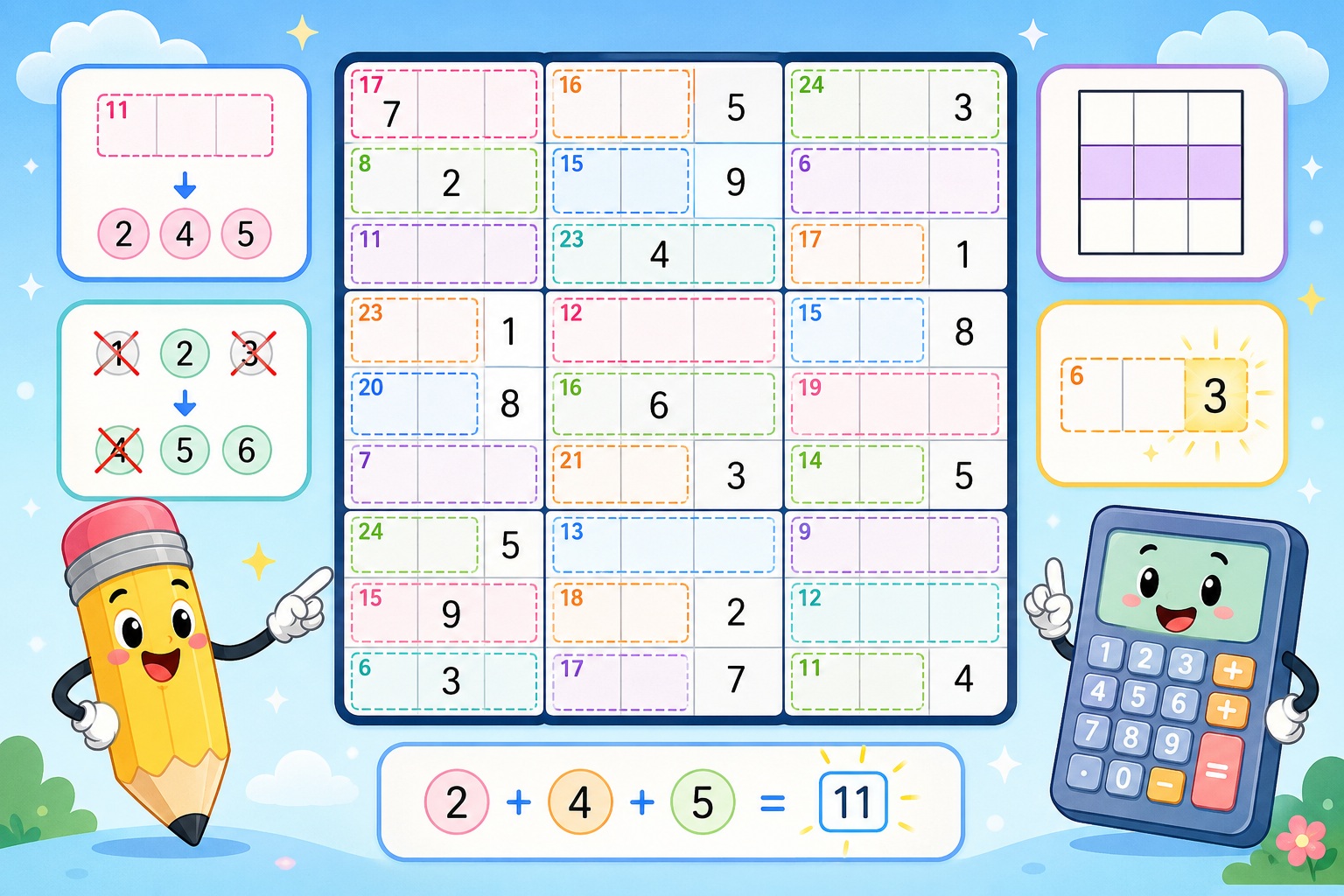
Killer Sudoku combinations are the arithmetic engine of every Killer puzzle. The cage total tells you the sum, the cage size tells you how many digits are involved, and the no-repeat rule usually means those digits must all be different.
This guide gives you the combination charts you actually need while solving: every 2-cell, 3-cell, and 4-cell cage sum, the minimum and maximum totals for larger cages, and a practical workflow for turning a long list of combinations into real Sudoku eliminations.
Quick answer
Killer Sudoku combinations are the possible groups of different digits that can fill a cage total. A 2-cell cage totaling 3 must be 1+2; a 3-cell cage totaling 24 must be 7+8+9. The fastest way to use combinations is to start with forced low and high sums, cross off digits already used in the row, column, or box, and rewrite the cage only when the remaining set gets smaller.
What Killer Sudoku combinations are
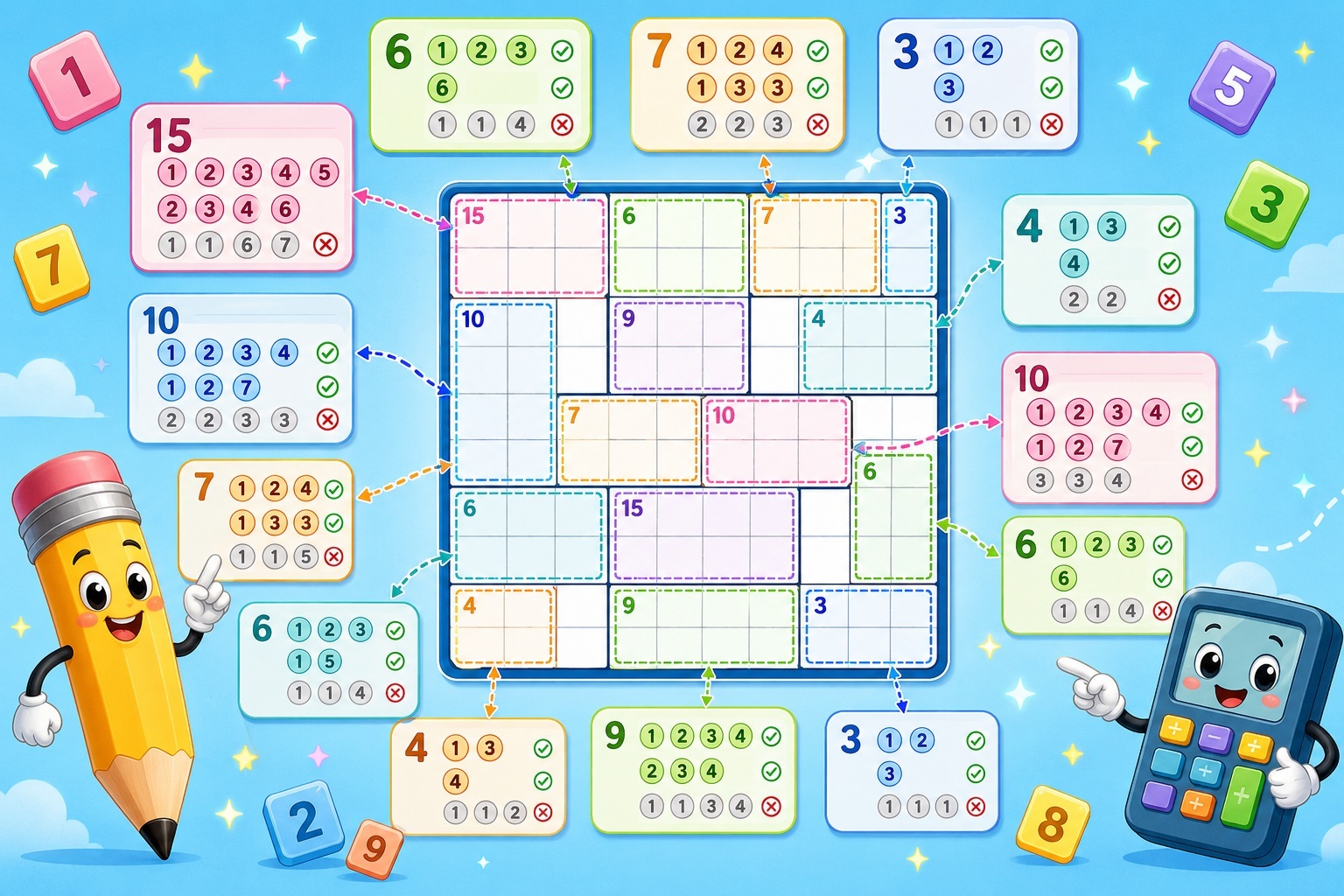
A Killer Sudoku cage is a group of cells with a small total in the corner. If a cage has two cells and the clue is 10, the digits might be 1+9, 2+8, 3+7, or 4+6. Those are the cage combinations.
Most Killer Sudoku puzzles add one more rule: digits cannot repeat inside a cage. That is why 5+5 is not allowed in a 2-cell 10 cage unless the puzzle explicitly says repeats are permitted.
How to use a combination chart
Do not copy every combination into the grid. Use the chart to find the possible groups, then immediately filter them through Sudoku rules. If a row already contains 8, every combination placing 8 in a cell in that row becomes weaker or impossible.
The best combinations are either forced, nearly forced, or restricted to a useful house. A cage with four possible digit groups is still valuable if all four groups contain a 7, or if all possible positions for 7 sit in the same box.
Killer Sudoku Tips
Pair this chart with a broader strategy guide for cages, innies and outies.
Read Tips Guide
Killer Sudoku Solver
Check a cage calculation or study the next logical step when you are stuck.
Open Killer Solver2-cell Killer Sudoku combinations
Two-cell cages are the easiest to memorize and the most common source of early progress. The extreme sums are forced, and the middle sums quickly become pairs once nearby digits are eliminated.
| Cage sum | Possible combinations | Usefulness |
|---|---|---|
| 2 cells = 3 | 1+2 | Forced |
| 2 cells = 4 | 1+3 | Forced |
| 2 cells = 5 | 1+4, 2+3 | 2 options |
| 2 cells = 6 | 1+5, 2+4 | 2 options |
| 2 cells = 7 | 1+6, 2+5, 3+4 | 3 options |
| 2 cells = 8 | 1+7, 2+6, 3+5 | 3 options |
| 2 cells = 9 | 1+8, 2+7, 3+6, 4+5 | 4 options |
| 2 cells = 10 | 1+9, 2+8, 3+7, 4+6 | 4 options |
| 2 cells = 11 | 2+9, 3+8, 4+7, 5+6 | 4 options |
| 2 cells = 12 | 3+9, 4+8, 5+7 | 3 options |
| 2 cells = 13 | 4+9, 5+8, 6+7 | 3 options |
| 2 cells = 14 | 5+9, 6+8 | 2 options |
| 2 cells = 15 | 6+9, 7+8 | 2 options |
| 2 cells = 16 | 7+9 | Forced |
| 2 cells = 17 | 8+9 | Forced |
3-cell Killer Sudoku combinations
Three-cell cages give more options, but the low and high ends are still very tight. Learn 6, 7, 23, and 24 first, then use the full chart when a cage sits in a crowded row, column, or box.
| Cage sum | Possible combinations | Usefulness |
|---|---|---|
| 3 cells = 6 | 1+2+3 | Forced |
| 3 cells = 7 | 1+2+4 | Forced |
| 3 cells = 8 | 1+2+5, 1+3+4 | 2 options |
| 3 cells = 9 | 1+2+6, 1+3+5, 2+3+4 | 3 options |
| 3 cells = 10 | 1+2+7, 1+3+6, 1+4+5, 2+3+5 | 4 options |
| 3 cells = 11 | 1+2+8, 1+3+7, 1+4+6, 2+3+6, 2+4+5 | 5 options |
| 3 cells = 12 | 1+2+9, 1+3+8, 1+4+7, 1+5+6, 2+3+7, 2+4+6, 3+4+5 | 7 options |
| 3 cells = 13 | 1+3+9, 1+4+8, 1+5+7, 2+3+8, 2+4+7, 2+5+6, 3+4+6 | 7 options |
| 3 cells = 14 | 1+4+9, 1+5+8, 1+6+7, 2+3+9, 2+4+8, 2+5+7, 3+4+7, 3+5+6 | 8 options |
| 3 cells = 15 | 1+5+9, 1+6+8, 2+4+9, 2+5+8, 2+6+7, 3+4+8, 3+5+7, 4+5+6 | 8 options |
| 3 cells = 16 | 1+6+9, 1+7+8, 2+5+9, 2+6+8, 3+4+9, 3+5+8, 3+6+7, 4+5+7 | 8 options |
| 3 cells = 17 | 1+7+9, 2+6+9, 2+7+8, 3+5+9, 3+6+8, 4+5+8, 4+6+7 | 7 options |
| 3 cells = 18 | 1+8+9, 2+7+9, 3+6+9, 3+7+8, 4+5+9, 4+6+8, 5+6+7 | 7 options |
| 3 cells = 19 | 2+8+9, 3+7+9, 4+6+9, 4+7+8, 5+6+8 | 5 options |
| 3 cells = 20 | 3+8+9, 4+7+9, 5+6+9, 5+7+8 | 4 options |
| 3 cells = 21 | 4+8+9, 5+7+9, 6+7+8 | 3 options |
| 3 cells = 22 | 5+8+9, 6+7+9 | 2 options |
| 3 cells = 23 | 6+8+9 | Forced |
| 3 cells = 24 | 7+8+9 | Forced |
4-cell Killer Sudoku combinations
Four-cell cages look broad, but their extremes are powerful. A 4-cell 10 cage is exactly 1+2+3+4, while a 4-cell 30 cage is exactly 6+7+8+9.
Middle totals have many choices, so focus on overlap: which digits appear in every option, which digits never appear, and whether a pair of cells can only contain the same two digits.
| Cage sum | Possible combinations | Usefulness |
|---|---|---|
| 4 cells = 10 | 1+2+3+4 | Forced |
| 4 cells = 11 | 1+2+3+5 | Forced |
| 4 cells = 12 | 1+2+3+6, 1+2+4+5 | 2 options |
| 4 cells = 13 | 1+2+3+7, 1+2+4+6, 1+3+4+5 | 3 options |
| 4 cells = 14 | 1+2+3+8, 1+2+4+7, 1+2+5+6, 1+3+4+6, 2+3+4+5 | 5 options |
| 4 cells = 15 | 1+2+3+9, 1+2+4+8, 1+2+5+7, 1+3+4+7, 1+3+5+6, 2+3+4+6 | 6 options |
| 4 cells = 16 | 1+2+4+9, 1+2+5+8, 1+2+6+7, 1+3+4+8, 1+3+5+7, 1+4+5+6, 2+3+4+7, 2+3+5+6 | 8 options |
| 4 cells = 17 | 1+2+5+9, 1+2+6+8, 1+3+4+9, 1+3+5+8, 1+3+6+7, 1+4+5+7, 2+3+4+8, 2+3+5+7, 2+4+5+6 | 9 options |
| 4 cells = 18 | 1+2+6+9, 1+2+7+8, 1+3+5+9, 1+3+6+8, 1+4+5+8, 1+4+6+7, 2+3+4+9, 2+3+5+8, 2+3+6+7, 2+4+5+7, 3+4+5+6 | 11 options |
| 4 cells = 19 | 1+2+7+9, 1+3+6+9, 1+3+7+8, 1+4+5+9, 1+4+6+8, 1+5+6+7, 2+3+5+9, 2+3+6+8, 2+4+5+8, 2+4+6+7, 3+4+5+7 | 11 options |
| 4 cells = 20 | 1+2+8+9, 1+3+7+9, 1+4+6+9, 1+4+7+8, 1+5+6+8, 2+3+6+9, 2+3+7+8, 2+4+5+9, 2+4+6+8, 2+5+6+7, 3+4+5+8, 3+4+6+7 | 12 options |
| 4 cells = 21 | 1+3+8+9, 1+4+7+9, 1+5+6+9, 1+5+7+8, 2+3+7+9, 2+4+6+9, 2+4+7+8, 2+5+6+8, 3+4+5+9, 3+4+6+8, 3+5+6+7 | 11 options |
| 4 cells = 22 | 1+4+8+9, 1+5+7+9, 1+6+7+8, 2+3+8+9, 2+4+7+9, 2+5+6+9, 2+5+7+8, 3+4+6+9, 3+4+7+8, 3+5+6+8, 4+5+6+7 | 11 options |
| 4 cells = 23 | 1+5+8+9, 1+6+7+9, 2+4+8+9, 2+5+7+9, 2+6+7+8, 3+4+7+9, 3+5+6+9, 3+5+7+8, 4+5+6+8 | 9 options |
| 4 cells = 24 | 1+6+8+9, 2+5+8+9, 2+6+7+9, 3+4+8+9, 3+5+7+9, 3+6+7+8, 4+5+6+9, 4+5+7+8 | 8 options |
| 4 cells = 25 | 1+7+8+9, 2+6+8+9, 3+5+8+9, 3+6+7+9, 4+5+7+9, 4+6+7+8 | 6 options |
| 4 cells = 26 | 2+7+8+9, 3+6+8+9, 4+5+8+9, 4+6+7+9, 5+6+7+8 | 5 options |
| 4 cells = 27 | 3+7+8+9, 4+6+8+9, 5+6+7+9 | 3 options |
| 4 cells = 28 | 4+7+8+9, 5+6+8+9 | 2 options |
| 4 cells = 29 | 5+7+8+9 | Forced |
| 4 cells = 30 | 6+7+8+9 | Forced |
Minimum and maximum cage sums
Before listing combinations, check whether a cage total is even possible. The lowest sum for k cells uses 1 through k; the highest uses the largest k digits.
This table is also useful for spotting forced extremes. If a cage is one away from the minimum or maximum, it often has only one or two realistic groups after normal Sudoku restrictions.
| Cage size | Lowest possible sum | Highest possible sum |
|---|---|---|
| 1 cells | 1 (1) | 9 (9) |
| 2 cells | 3 (1+2) | 17 (8+9) |
| 3 cells | 6 (1+2+3) | 24 (7+8+9) |
| 4 cells | 10 (1+2+3+4) | 30 (6+7+8+9) |
| 5 cells | 15 (1+2+3+4+5) | 35 (5+6+7+8+9) |
| 6 cells | 21 (1+2+3+4+5+6) | 39 (4+5+6+7+8+9) |
| 7 cells | 28 (1+2+3+4+5+6+7) | 42 (3+4+5+6+7+8+9) |
| 8 cells | 36 (1+2+3+4+5+6+7+8) | 44 (2+3+4+5+6+7+8+9) |
| 9 cells | 45 (1+2+3+4+5+6+7+8+9) | 45 (1+2+3+4+5+6+7+8+9) |
How to handle 5+ cell cages
Large cages are usually easier through complements than through long lists. All digits 1 to 9 add to 45, so a 5-cell cage totaling 35 is the same as saying the four missing digits total 10. The missing digits must be 1+2+3+4, so the cage contains 5+6+7+8+9.
Use the same idea for 6-cell, 7-cell, and 8-cell cages. A 7-cell cage is often best understood by the two digits it does not contain.
How to reduce combinations
A raw combination is only the start. Remove any digit already placed in the same row, column, or box as a cage cell. Then ask whether the remaining digits can actually be arranged across the cage cells.
Suppose a 3-cell cage totals 15. The chart lists 1+5+9, 1+6+8, 2+4+9, 2+5+8, 2+6+7, 3+4+8, 3+5+7, and 4+5+6. If one cage cell sees every 9 in its row and box, every option that requires 9 in that cell disappears. If 9 can go nowhere in the cage, all 9-combinations disappear.
Combinations and the rule of 45
Each row, column, and 3x3 box totals 45. That lets you create new cage sums from groups of cages. If cages inside a box total 42 and one uncovered cell remains, that cell is 3.
The rule of 45 is especially strong when it creates a two-cell sum. A pair totaling 16 can only be 7+9, and a pair totaling 4 can only be 1+3. Once the arithmetic gives you a small cage, the combination chart turns it into Sudoku logic.
Notation that stays readable
Keep cage combinations separate from cell candidates. Cell candidates answer "what can go here?" Cage combinations answer "which group can fill this cage?" Mixing the two makes hard Killer puzzles feel messier than they are.
Write full cage combinations only when there are a few left. For broad totals, note forced digits, excluded digits, or a short label such as "no 9" or "must include 4". After a placement, update the touched cage immediately.
Worked examples
Example 1: a 2-cell 17 cage is 8+9. If one of its cells is in a column that already has 9, that cell must be 8 and the other cell must be 9.
Example 2: a 3-cell 7 cage is 1+2+4. If the cage occupies two cells in one box and one cell in another box, those three digits are locked to the cage. None of 1, 2, or 4 can repeat inside the cage, and any solved 1, 2, or 4 nearby can place the rest.
Example 3: a box has cages totaling 50 with one outie outside the box. Since the box itself totals 45, the outie is 5. That single digit may reduce its cage to a forced pair.
Common Killer Sudoku combination mistakes
The first mistake is allowing repeated digits in a cage by accident. In the standard rules, 5+5 is not a valid 10 pair.
The second mistake is treating a combination as a placement. A 3-cell 24 cage tells you the cage uses 7, 8, and 9; it does not tell you which cell receives which digit until row, column, and box logic decide.
The third mistake is over-noting. If a cage has ten possible groups, writing all ten may hide the useful fact that only one digit is forced or only one digit is impossible.
Bottom line
Killer Sudoku combinations are most powerful when they stay connected to Sudoku logic. Use the chart to shrink cage totals, then let rows, columns, boxes, pairs, and singles do the rest.
FAQ
They are the possible sets of different digits that add to a cage total. For example, a 2-cell cage totaling 16 can only be 7+9.
Usually no. Standard Killer Sudoku cages do not repeat digits, unless the puzzle states a different rule.
Memorize the forced extremes first: 2-cell 3, 4, 16, 17; 3-cell 6, 7, 23, 24; and 4-cell 10 and 30.
Use complements. Since 1 through 9 totals 45, a large cage can often be understood by the digits missing from it.
No. A combination is a possible group for the whole cage. A candidate is a possible digit for one cell. Good solving keeps both ideas separate.